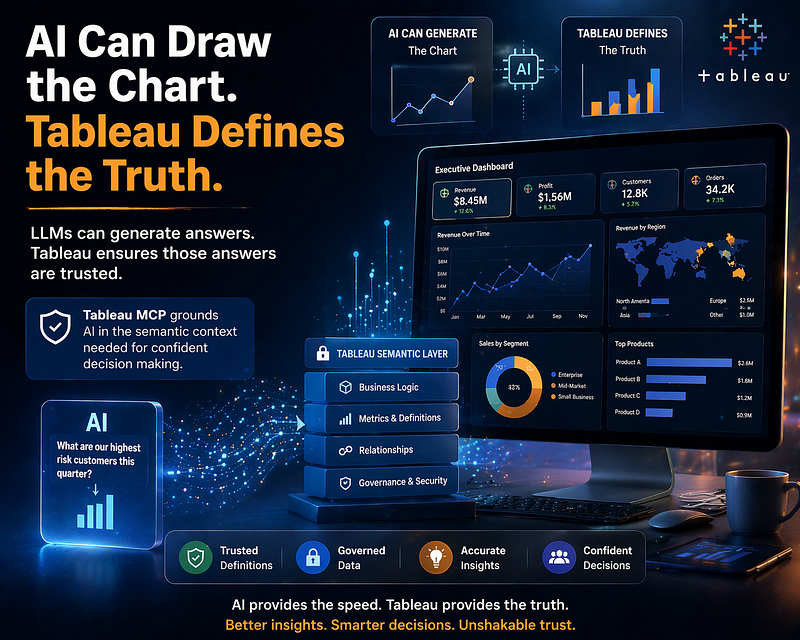
AI can generate charts in seconds.
But here’s the uncomfortable truth: most businesses are starting to realize:
Not every chart deserves to be trusted.
This is exactly where Tableau dashboard design becomes more important than ever. Because in a world where AI can generate answers instantly, the real advantage is no longer speed — it’s accuracy.
And accuracy doesn’t come from AI alone.
It comes from the foundation your data is built on.
The Shift from “Fast Insights” to “Trusted Insights”
For years, businesses have invested in data analytics services to make better decisions. The focus was on collecting more data, building dashboards, and improving reporting speed.
Now, AI has changed the game.
You can ask a question and get a chart instantly.
You can generate summaries without writing a single query.
But here’s the problem:
AI doesn’t inherently understand your business.
It doesn’t know:
- How do you define revenue
- What qualifies as a high-value customer
- Which KPIs actually matter
Without that context, even the most beautiful visualization can be misleading.
This is why organizations are shifting from just data visualization services to building systems that ensure every insight is grounded in reality.
Why Tableau Dashboard Design Still Leads in the AI Era
Tableau has always been more than a visualization tool.
It’s a system where businesses define how their data should be interpreted.
Every metric, every calculation, every relationship —
It is carefully structured inside a semantic layer.
This is what makes enterprise data visualization reliable.
When AI connects to raw data, it guesses.
When AI connects to Tableau, it understands.
That’s the difference.
A well-built Tableau system ensures:
- Consistent definitions across teams
- Governed data access and security
- Reliable, repeatable insights
This is why companies investing in Tableau dashboard services aren’t just building dashboards — they’re building a source of truth.
The Role of Business Intelligence Consulting in AI Adoption
Most businesses are experimenting with AI.
Very few are preparing their data for it.
This gap is where business intelligence consulting plays a critical role.
Because AI without structure creates confusion at scale.
A proper BI strategy focuses on:
- Defining business metrics clearly
- Aligning data models across systems
- Ensuring governance and consistency
This is where analytics and reporting consulting becomes essential — not just for building dashboards, but for making AI outputs usable.
AI + Tableau: From Data to Decision-Ready Insights
Let’s break this down with a simple example.
A business asks:
“What are our highest-risk customers this quarter?”
An AI model connected directly to raw data might:
- Pull incomplete signals
- Misinterpret definitions
- Generate a visually appealing but incorrect answer
Now, connect that same AI to a Tableau-backed system.
Suddenly, it understands:
- What “high-risk” actually means
- Which metrics define customer health
- How different variables interact
The output changes completely.
It’s no longer just a chart.
It’s a decision-ready insight.
This is the power of combining AI with interactive business dashboards built on strong data foundations.
Building a System of Understanding, Not Just Reporting
Most dashboards today are still built for reporting.
They answer: What happened?
But modern businesses need more than that.
They need systems that answer:
- Why did it happen?
- What will happen next?
- What should we do about it?
This shift requires more than tools.
It requires:
- Strong data modeling services
- A unified reporting data model
- Clear KPI frameworks
This is how organizations move toward decision-ready data visualization.
The Hidden Risk of AI Without Data Governance
AI makes it easy to generate answers.
Too easy.
And that creates a new kind of risk.
When different teams get different answers to the same question, trust breaks.
Without governance:
- Metrics get redefined inconsistently
- Reports contradict each other
- Decision-making slows down
This is why KPI strategy consulting and business-aligned metrics frameworks are becoming critical.
Because the real challenge isn’t generating insights.
It’s ensuring everyone is working from the same truth.
How Visualizexpert Helps Businesses Build Trusted Analytics
At Visualizexpert, the focus isn’t just on dashboards — it’s on building systems that businesses can rely on.
This includes:
- Designing scalable interactive dashboard design frameworks
- Creating consistent, governed data models
- Delivering executive analytics dashboards that drive decisions
- Enabling real-time data dashboards through structured integrations
The goal is simple:
Turn data into something teams can trust.
Because without trust, even the most advanced analytics tools fail.
The Future: Agentic Analytics Needs a Strong Foundation
We’re entering an era where AI doesn’t just assist — it acts.
Agentic analytics systems will:
- Analyze data automatically
- Generate insights continuously
- Recommend actions in real time
But none of this works without a solid data foundation.
This is where:
- Cloud data warehouse integration
- data pipeline automation
- scalable data models
become non-negotiable.
Because AI is only as reliable as the system it operates on.
Final Thoughts
AI can draw the chart.
But it cannot define the truth behind it.
That responsibility still belongs to your data systems.
And that’s why Tableau continues to play a critical role in modern analytics.
Not as a visualization tool —
But as a system of understanding.
If your organization is exploring AI but struggling with data consistency, it’s time to fix the foundation first.
Explore how Visualizexpert can help you build trusted, scalable analytics systems at:
👉 Visualizexpert.com
Because in the end, it’s not about how fast you get answers.
It’s about whether you can trust them.
Leave a Reply