Introduction: The Real Problem Isn’t Data — It’s Delay
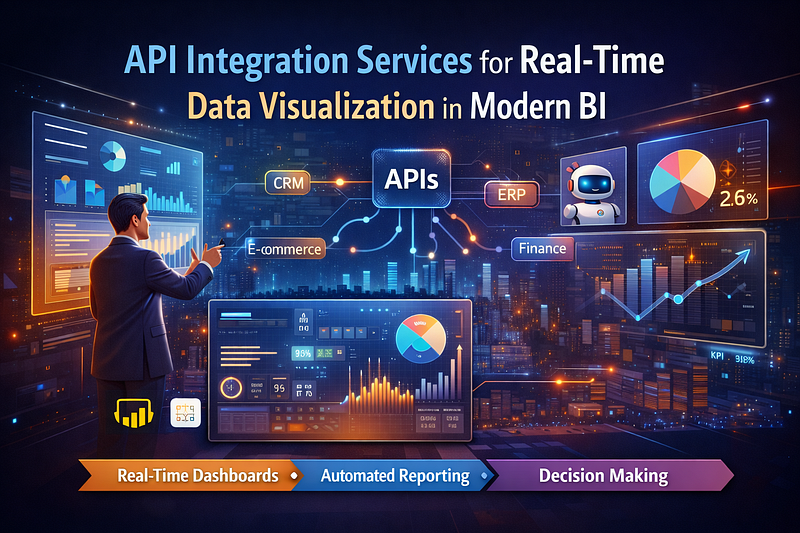
Most businesses today are surrounded by data, yet they struggle to act on it at the right time.
Sales numbers sit in one system. Marketing insights live somewhere else. Financial data gets updated separately. By the time all of this is compiled into a report, the moment to act has often passed.
This is where API Integration Services become critical.
Instead of manually exporting, cleaning, and combining data, APIs allow systems to communicate with each other in real time. The result is not just faster reporting, but a complete shift toward data visualization for decision making.
At VisualizExpert, this shift is at the core of how modern analytics systems are built — focused not just on visibility, but on speed and clarity.
What API Integration Really Means for Business Intelligence
At its core, API integration is about connection.
It connects platforms, tools, and data sources so that information flows automatically instead of being handled manually. This eliminates the repetitive work that slows down analytics teams and introduces errors.
When businesses adopt data integration services, they move away from static reporting and toward systems that update continuously. This is what makes real-time data dashboards possible.
Instead of asking, “What happened last week?”, decision-makers can now ask, “What’s happening right now?”
The Shift from Manual Reporting to Intelligent Systems
Traditional BI workflows were heavily dependent on analysts. Every request required time — time to extract data, clean it, transform it, and finally present it.
This process was not only slow but also difficult to scale.
With modern systems powered by automated reporting solutions, much of this process is handled automatically. Data flows through pipelines, updates dashboards, and becomes instantly available to stakeholders.
The difference is not just efficiency — it’s impact. Businesses no longer wait for insights. They operate with them in real time.
How Integration Enables Better Decision-Making
When data is fragmented, decisions become uncertain.
Different teams rely on different numbers. Reports don’t match. Confidence drops.
But when systems are connected through APIs, businesses can build a unified reporting data model that ensures consistency across the organization.
This creates a single source of truth.
From there, interactive business dashboards transform that data into something usable. Instead of scanning through spreadsheets, users can explore trends, identify issues, and take action immediately.
This is where data stops being informational and starts becoming operational.
The Role of Modern Dashboarding Tools
Once the data is integrated, the next step is presenting it in a way that drives action.
Tools like Power BI and Tableau have become essential in this process.
With Power BI Dashboard Development, businesses can create dynamic dashboards that pull data from multiple sources and update automatically. Combined with Power BI data modeling, these dashboards become structured, scalable, and easy to interpret.
On the other hand, Tableau dashboard services focus heavily on visual storytelling. With interactive Tableau dashboards, users can explore data in a more intuitive way, uncovering insights that static reports would never reveal.
Both tools, when used strategically, enable organizations to move toward decision-ready data visualization.
Why Businesses Still Struggle Despite Having Tools
Many organizations invest in tools but still fail to see results.
The reason is simple — they focus on tools instead of systems.
Without a clear strategy, dashboards become cluttered. Metrics become confusing. Teams spend more time interpreting data than acting on it.
This is where analytics strategy services play a crucial role.
A well-defined strategy answers key questions:
- What metrics actually matter?
- How should data be structured?
- What decisions should dashboards support?
Without these answers, even the most advanced tools fail to deliver value.
Building a Scalable Analytics Ecosystem
To truly benefit from API integration, businesses need more than just connections — they need a scalable system.
This involves multiple layers working together seamlessly:
- Data flows through data pipeline automation, ensuring continuous updates
- Systems are designed with scalable data models to handle growth
- Dashboards are built for usability, not just visibility
When these elements come together, businesses achieve what many aim for but few accomplish — automated BI reporting that actually supports decision-making.
Real-World Impact Across Business Functions
The impact of integrated analytics can be seen across departments.
In marketing, marketing analytics dashboards allow teams to monitor campaign performance and adjust strategies in real time. Instead of waiting for reports, they can optimize continuously.
In sales, a sales analytics dashboard provides visibility into pipeline health, conversion rates, and revenue trends, helping teams make faster and more informed decisions.
Operations teams benefit from operations analytics dashboards, where inefficiencies can be identified and resolved before they become larger issues.
Across all functions, the result is the same — better visibility, faster action, and improved outcomes.
The Competitive Advantage of Real-Time Data
In today’s environment, speed is everything.
Markets shift quickly. Customer behavior changes constantly. Opportunities appear and disappear in moments.
Businesses that rely on delayed insights are always reacting.
Those with real-time data dashboards are able to anticipate, adapt, and act.
This is what creates a true competitive advantage.
It’s not about having more data. It’s about using it faster and better.
Why VisualizExpert Focuses on End-to-End Solutions
At VisualizExpert, the goal is not just to build dashboards.
It’s to create systems where data flows seamlessly from source to insight to decision.
This includes:
- Integrating multiple platforms through APIs
- Designing structured data models
- Building intuitive and interactive dashboards
- Aligning analytics with business goals
The result is a system that doesn’t just report what happened, but actively supports what should happen next.
The Future of Business Intelligence
We are moving toward a future where analytics is not a separate function — it’s embedded into everyday decision-making.
Data will no longer need to be requested. It will be available instantly.
Insights will not need to be interpreted manually. They will be presented clearly and contextually.
Systems will not just display data. They will guide actions.
This transformation is already underway, and API integration is at the center of it.
Final Thoughts
The way businesses use data is changing rapidly.
Static reports are being replaced by dynamic systems. Manual processes are being replaced by automation. Fragmented data is being replaced by unified ecosystems.
API integration is what makes all of this possible.
Without it, data remains disconnected and underutilized.
With it, businesses gain clarity, speed, and confidence in every decision they make.
Ready to Build a Smarter Data System?
If your business is still relying on manual reporting or disconnected dashboards, it’s time to rethink your approach.
Explore how VisualizExpert.com can help you build real-time, scalable, and decision-driven analytics systems tailored to your needs.
Turn your data into something that doesn’t just inform —
but drives real business growth.
Leave a Reply