Growth Rarely Breaks Overnight — It Quietly Slows Down
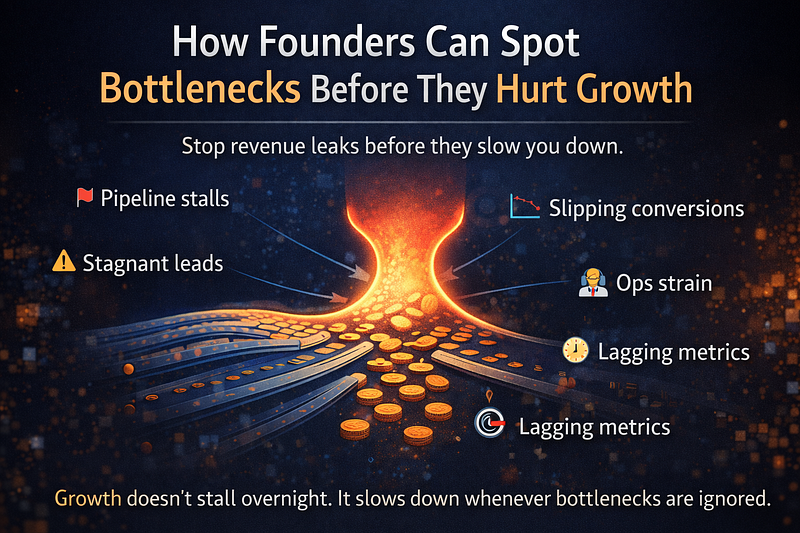
Most founders don’t wake up to a sudden growth crisis.
Revenue doesn’t collapse in a single quarter. Customers don’t disappear in a week.
Instead, growth gradually slows — buried under operational friction, unclear metrics, and dashboards that report activity instead of insight.
This is where executive analytics dashboards become critical. Not as reporting tools, but as early-warning systems. When designed correctly, dashboards help founders spot bottlenecks before they damage momentum, cash flow, or team morale.
At scale, growth bottlenecks are not operational accidents. They are visibility failures.
Why Founders Miss Bottlenecks Even When They “Have Data”
Most growing companies already invest in data visualization services, reporting tools, and dashboards. Yet bottlenecks still slip through.
The problem isn’t data volume.
It’s data relevance.
Common reasons bottlenecks go unnoticed:
- Dashboards show what happened, not where pressure is building
- Metrics are siloed across sales, marketing, and operations
- Founders see too many numbers but too few signals
- Reports are built for teams, not leadership decisions
This is where business intelligence consulting shifts from reporting to strategy — helping founders focus on constraints, not clutter.
Bottlenecks Are Patterns, Not Single Metrics
A bottleneck is rarely one bad number.
It’s a pattern across systems.
For example:
- Marketing leads are growing, but sales velocity is flat
- Revenue is rising, but cash flow is tightening
- Customer acquisition improves, but retention quietly drops
These signals only surface when dashboards are built with contextual relationships, not isolated KPIs.
This is the difference between basic BI dashboard solutions and decision-ready data visualization.
Using KPI Dashboard Services to Detect Bottlenecks Early
Effective KPI dashboard services don’t aim to track everything. They are designed to expose constraints in the growth engine.
For founders, the most common bottleneck zones include:
- Demand flow: Lead quality, conversion velocity, pipeline aging
- Revenue realization: Discounting, margin compression, delayed collections
- Operations: Fulfillment delays, capacity strain, rising cost per unit
- Retention: Churn signals hidden behind top-line growth
Dashboards that connect these metrics reveal where growth is slowing — before results collapse.
Why Executive Dashboards Should Reduce Data, Not Add More
Founders don’t need diagnostic depth.
They need directional clarity.
High-performing executive dashboards share three traits:
- Few metrics, high meaning
- Trend-based views instead of raw tables
- Visual hierarchy that surfaces risk instantly
This is where interactive business dashboards outperform static reports — allowing founders to drill only when something breaks pattern.
Spotting Bottlenecks Across the Growth Funnel
Bottlenecks shift as companies scale. Dashboards must evolve with them.
Early-Stage Growth
- Lead velocity vs. sales capacity
- Conversion drop-offs by stage
Scale-Up Phase
- Revenue per customer vs. acquisition cost
- Operational throughput vs. demand
Mature Growth
- Retention erosion
- Margin dilution
- Forecast accuracy gaps
Dashboards that fail to evolve often mask bottlenecks rather than expose them.
Why Automation Alone Doesn’t Solve Visibility Problems
Many founders invest in Power BI dashboards or automated reporting, expecting clarity to improve automatically.
Automation removes manual work — not confusion.
Without intentional design:
- Automated reports amplify noise
- Dashboards refresh faster, but stay misaligned
- Founders react late, not early
This is why analytics and reporting consulting matters. It ensures automation supports decisions, not distractions.
Turning Dashboards into Constraint-Focused Systems
Advanced teams design dashboards around constraints, not departments.
This includes:
- Linking sales velocity to delivery capacity
- Mapping marketing spend to cash-flow impact
- Aligning hiring pace with revenue predictability
This systems view is central to enterprise data visualization — even for mid-market and founder-led companies.
Data Modeling Matters More Than Chart Design
Many bottlenecks remain invisible because dashboards are built on weak models.
Strong dashboards rely on:
- Clean metric definitions
- Consistent time granularity
- Unified reporting layers
This foundation enables custom analytics solutions that scale without breaking trust.
Bottlenecks Across Teams Need Shared Visibility
Growth constraints rarely belong to one team.
Sales feels the pain.
Operations absorb the pressure.
Finance sees the impact last.
Dashboards must create shared accountability, not departmental silos. This is why founders benefit from shareable stakeholder reports that align teams around the same truth.
From Reactive Reporting to Proactive Leadership
Founders who spot bottlenecks early share one habit:
They don’t wait for performance reviews to learn what’s broken.
They rely on:
- Continuous visibility
- Leading indicators
- Scenario-aware dashboards
This mindset shift is at the heart of data-driven decision making.
Governance: Visibility Without Overexposure
While visibility matters, not all data belongs on executive screens.
Effective dashboards:
- Hide operational noise
- Surface decision-level signals
- Protect sensitive details
This balance is essential for long-term trust in analytics.
Why Bottleneck Detection Is a Strategic Advantage
Companies that detect constraints early:
- Reallocate resources faster
- Avoid panic hiring or spending
- Protect margins during scale
This is why bottleneck-focused dashboards are not reporting tools — they’re growth insurance.
How VisualizExpert Helps Founders Stay Ahead of Bottlenecks
At VisualizExpert, we help founders move beyond static dashboards to decision-ready analytics systems.
Our work focuses on:
- Designing executive analytics dashboards aligned to growth stages
- Building KPI frameworks that expose constraints early
- Creating scalable reporting models that evolve with the business
- Delivering clarity without overwhelming leadership
We don’t build dashboards for presentation.
We build dashboards for foresight.
Final Thoughts: Growth Slows When Bottlenecks Go Unseen
Bottlenecks don’t announce themselves.
They hide in trends, timing gaps, and misaligned metrics.
Founders who rely on surface-level dashboards see problems late.
Founders who invest in constraint-aware analytics act early.
If your dashboards show activity but not friction, growth risk is already accumulating.
VisualizExpert helps founders design analytics systems that surface bottlenecks before they hurt growth — turning dashboards into strategic assets, not reporting overhead.
Leave a Reply