Category: Uncategorized

  • Power BI Dashboard Development for Enterprise-Scale Analytics Observability


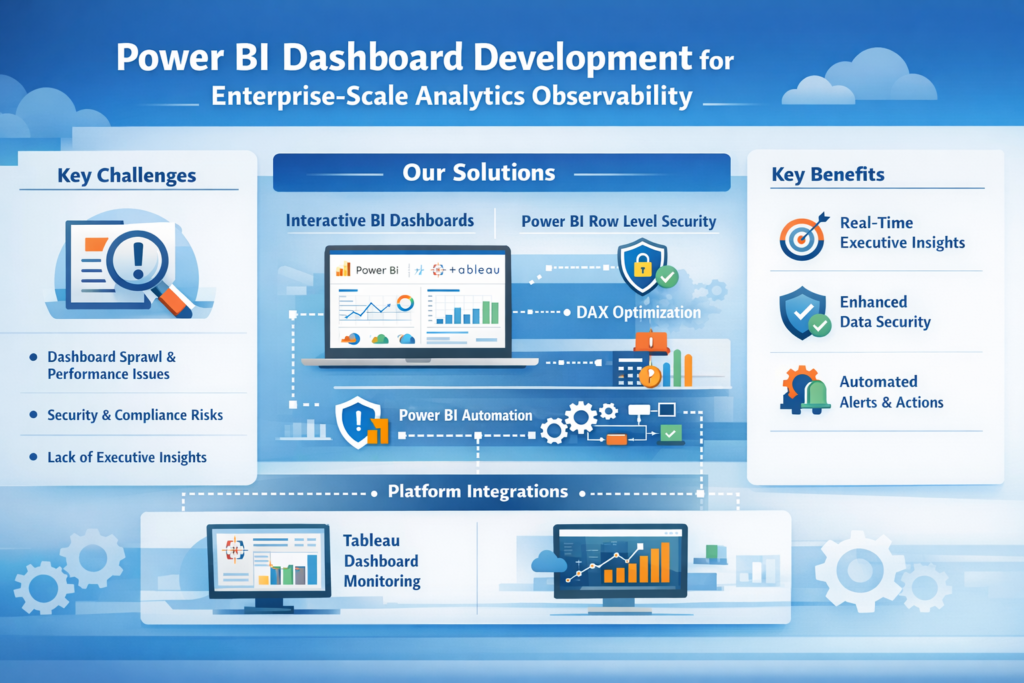
    Modern analytics platforms are no longer just reporting tools — they are mission-critical systems that power daily business decisions. As organizations scale their analytics footprint, Power BI Dashboard Development becomes central to ensuring leaders have visibility into performance, governance, and risk. The challenge is not only building dashboards, but continuously monitoring usage, security, data freshness, and operational health across thousands of users and assets.

    At VisualizExpert, we work with enterprises that have outgrown ad-hoc reporting and manual administration. They need observability, automation, and decision-ready insights — without adding operational complexity.


    The Observability Gap in Growing Analytics Environments

    Self-service BI adoption is a success story — until it isn’t. As dashboards multiply, so do problems: duplicated metrics, unused reports, slow queries, and unclear ownership. Built-in admin tools often fail to answer enterprise-level questions such as:

    • Which dashboards are critical to executives but at risk of failure?
    • Where are performance bottlenecks emerging?
    • Are users accessing only the data they are authorized to see?

    This is where business intelligence consulting shifts from visualization to platform strategy. Enterprises need a structured analytics operating model that connects usage data, performance telemetry, and governance signals into one coherent view.


    Why Platform Observability Is Now a BI Requirement

    Observability is no longer exclusive to IT infrastructure. Analytics platforms themselves must be observable — measurable, auditable, and optimizable. Leading organizations integrate platform event data with analytics and reporting consulting frameworks to proactively manage risk instead of reacting to incidents.

    At VisualizExpert, we help organizations transform raw platform logs into executive-level intelligence that answers “what’s happening, why it matters, and what to do next.”


    Power BI Dashboard Development as an Observability Layer

    How Power BI Becomes the Control Plane

    When designed correctly, Power BI dashboards can act as a real-time control plane for analytics operations. Using Power BI Data Modeling Services, platform activity data can be shaped into star schemas that support fast, scalable analysis of usage trends, refresh reliability, and adoption patterns.

    This is not traditional reporting. It is operational intelligence for analytics leaders.


    Governance Without Friction Using Power BI Row Level Security

    Security failures in analytics are rarely malicious — they are usually accidental. Misconfigured permissions, inherited access, and forgotten users create silent risk. By applying Power BI Row Level Security, organizations can ensure that operational dashboards show the right insights to the right stakeholders without exposing sensitive metadata.

    This approach aligns compliance with usability, a key requirement for regulated industries.


    Executive Visibility Through KPI-Driven Monitoring

    Leadership teams do not want logs — they want answers. VisualizExpert designs executive analytics dashboards that translate platform health into KPIs such as adoption velocity, report reliability, and business impact coverage. These dashboards enable faster intervention and more confident decision-making.


    Tableau Cloud, Platform APIs, and Cross-Tool Strategy

    Many enterprises operate hybrid BI ecosystems. Tableau remains critical for visual exploration and storytelling, while Power BI often becomes the enterprise monitoring layer. Our Tableau Dashboard Design expertise ensures that Tableau environments remain performant and trusted, even as usage scales globally.

    Tableau Observability with Platform Event Data

    By combining Tableau event streams with Tableau Server Optimization techniques, organizations can identify extract failures, slow dashboards, and unused assets before they impact users.


    H2: Power BI Dashboard Development for Platform Observability at Scale

    True observability requires more than visuals — it requires architecture. VisualizExpert designs interactive business dashboards that connect platform APIs, warehouse telemetry, and governance metadata into a unified monitoring experience. These dashboards answer not only “what happened,” but “what should we fix next?”

    This is where analytics maturity becomes a competitive advantage.


    Automation: From Monitoring to Action

    Observability without action is just awareness. By applying Power BI automation, we help enterprises trigger alerts, workflows, and remediation steps when thresholds are breached — whether that’s a failed refresh, a sudden spike in query load, or a permissions change.

    Automation reduces operational overhead while increasing platform reliability.


    Data Integrity and Modeling Excellence

    Platform data is only valuable if it is trustworthy. Using DAX Formula Optimization, we ensure that operational metrics remain accurate at scale, even as event volumes grow into millions of records per day. This protects confidence in analytics leadership dashboards.


    Embedded Analytics for Platform Teams

    Analytics teams themselves need analytics. Through Power BI Embedded Analytics, platform health insights can be delivered directly inside admin portals, IT dashboards, or internal tools — reducing context switching and accelerating response time.


    Tableau Expertise for Advanced Use Cases

    Complex organizations often require advanced Tableau capabilities. Our Tableau LOD Calculation Expert services enable precise measurement of usage, adoption, and performance across multiple dimensions — without sacrificing visual clarity.

    Meanwhile, Tableau visual analytics ensures that insights remain accessible to both technical and non-technical stakeholders.


    Enterprise-Grade Performance and Scalability

    As usage grows, performance becomes a strategic issue. We design enterprise data visualization solutions that scale across regions, user groups, and data volumes — without degrading experience. This includes proactive performance modeling and capacity planning.


    The VisualizExpert Difference

    VisualizExpert is not just a dashboard vendor — we are a strategic analytics partner. Our work spans BI dashboard solutions, platform governance, and long-term analytics enablement. We help enterprises move from reactive administration to proactive intelligence.

    Our approach is grounded in real-world experience, not templates. Every engagement is aligned to business outcomes, not vanity metrics.


    Preparing for the Future of Analytics Operations

    As analytics platforms evolve, observability will become non-negotiable. APIs, event data, and automation will define how organizations maintain trust in their insights. VisualizExpert helps enterprises prepare for that future today — by building systems that are transparent, resilient, and decision-ready.


    Final Thoughts

    Enterprise analytics success is no longer defined by how many dashboards you have — but by how well you understand, govern, and evolve your analytics ecosystem. With the right observability strategy and expert execution, analytics becomes a source of confidence rather than complexity.

    If your organization is scaling analytics and needs clarity at every level, VisualizExpert is ready to help.
  • BI and Analytics Tool Selection Framework: A Practical Guide for Confident Decisions


    Introduction: Why BI Tool Selection Fails More Often Than It Should

    Selecting a BI and analytics platform is no longer a purely technical decision — it is a strategic one that directly influences how leaders interpret data and act on it. Organizations often invest months evaluating tools, yet still struggle with adoption, performance, or trust in insights. This is where Power BI consulting services play a critical role, helping businesses move beyond surface-level comparisons and toward platforms that truly align with their data maturity, operating model, and long-term goals.

    At VisualizExpert, we’ve seen a consistent pattern: BI tools fail not because they lack features, but because they are selected without a structured evaluation framework. A successful BI selection process balances architecture, usability, scalability, governance, and future readiness. This article outlines a practical BI and analytics tool selection framework — one that prioritizes real-world decision impact over vendor hype.


    Why a Framework Matters More Than a Feature Checklist

    Modern BI platforms all promise speed, self-service, AI-assisted insights, and beautiful dashboards. Yet organizations still face dashboard sprawl, inconsistent metrics, and slow decision cycles. The problem lies in how tools are selected.

    A framework forces clarity around:

    • Who will use the tool and how
    • Where data transformation should live
    • How governance and scalability will be enforced
    • What success looks like after implementation

    Without this structure, even best-in-class tools become underutilized reporting layers instead of decision engines.


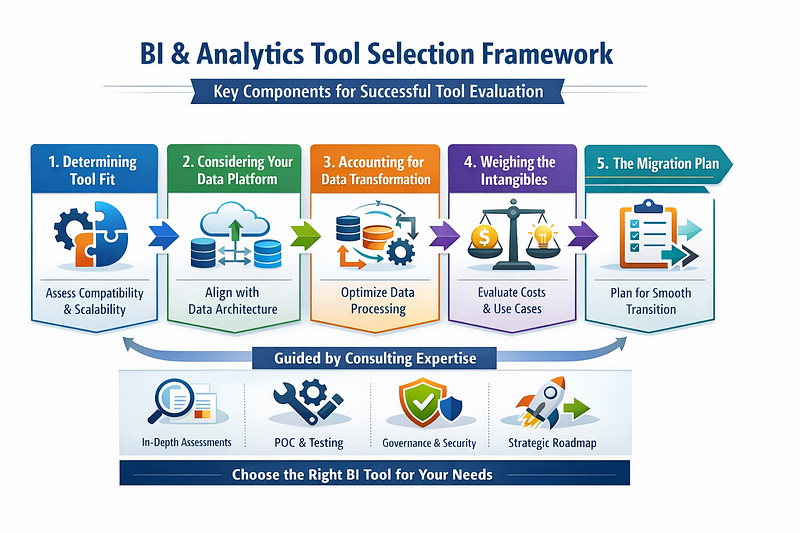
    Core Component 1: Determining True Tool Fit

    Tool fit goes beyond compatibility with data sources. It evaluates how well a BI platform integrates into your organization’s operating reality — today and three years from now.

    Key considerations include:

    • Alignment with your current and future data architecture
    • Learning curve for both analysts and business users
    • Licensing model sustainability as adoption grows
    • Performance under real data volumes and concurrency

    The most successful BI environments are not those with the most dashboards, but those where analytics naturally integrates into everyday decision-making. Fit should be validated through hands-on proof-of-concepts that mirror real workflows, not sanitized demos.


    Core Component 2: Data Platform Alignment

    BI tools do not exist in isolation. They sit at the top of your data stack and depend heavily on what exists beneath them.

    Organizations generally fall into one of three platform scenarios:

    Modular Data Platforms

    These environments combine best-of-breed tools for ingestion, transformation, storage, and analytics. The BI tool must work efficiently with cloud warehouses, semantic models, and transformation layers without duplicating logic.

    Vendor-Centric Cloud Platforms

    Unified ecosystems provide deep integration benefits but often nudge organizations toward native BI tools. While this can accelerate deployment, it may also introduce long-term vendor dependency that must be evaluated carefully.

    No Centralized Data Platform

    In less mature environments, the BI tool often absorbs responsibilities it was not designed for — data preparation, transformation, and even storage. This can work short-term but introduces technical debt unless paired with a roadmap toward centralization.

    Understanding your platform direction is essential before locking in a BI tool.


    Core Component 3: Where Data Transformation Should Live

    One of the most overlooked decisions in BI selection is where transformation logic resides. While many BI tools allow data shaping, relying on them as the primary transformation layer limits scalability and complicates future migrations.

    Best-practice principles include:

    • Centralizing complex transformations in the data platform
    • Keeping BI-level calculations lightweight and presentation-focused
    • Designing semantic models that remain portable across tools

    This separation ensures performance, governance, and long-term flexibility — especially as data volumes and user counts increase.


    How Power BI Consulting Services Improve BI Tool Selection Outcomes

    Organizations that engage experienced Power BI consulting services during the selection phase consistently achieve higher adoption and faster time-to-value. This is not because consultants push a specific tool, but because they bring a decision-first mindset.

    Consulting-led selection helps organizations:

    • Translate business decisions into analytics requirements
    • Identify hidden architectural constraints early
    • Stress-test tools under realistic workloads
    • Design governance and security models before rollout

    Rather than asking “What can this tool do?”, the conversation shifts to “What decisions must this tool support reliably?”

    This approach reduces rework, minimizes shelfware, and ensures the BI platform evolves with the organization — not against it.


    Core Component 4: Weighing the Intangibles

    Technical capability alone does not determine success. Intangible factors often make or break BI adoption.

    Licensing Trajectory

    Costs rarely stay flat. Organizations must model how licensing scales with usage, viewer counts, and premium features — not just initial pricing.

    Real Use Cases Over Feature Depth

    Advanced functionality has little value if it does not support actual decision scenarios. Prioritize the workflows that matter most to leadership, operations, and frontline teams.

    Vendor Momentum and Ecosystem

    An active product roadmap, strong community, and skilled talent pool signal long-term viability. A stagnant ecosystem increases future risk.

    These factors are difficult to quantify — but ignoring them is costly.


    Core Component 5: Migration as a Strategic Opportunity

    Migration should never be treated as a lift-and-shift exercise. It is a rare opportunity to clean, rationalize, and improve your analytics environment.

    Successful migration planning addresses:

    • Which reports truly deliver value
    • Whether required data is accessible and trustworthy
    • How change management will minimize disruption

    Phased cutovers, parallel runs, and strong communication ensure users trust the new platform from day one. When executed well, migration accelerates adoption rather than slowing it.


    Key Takeaways for BI Leaders

    • BI tool selection is a strategic decision, not a procurement task
    • Architecture, governance, and usability matter more than feature volume
    • Data transformation should be centralized, not buried in dashboards
    • Intangibles like licensing and ecosystem health shape long-term success
    • Migration is a chance to reset — not replicate — analytics debt

    Most importantly, the right BI tool is the one that consistently supports better decisions at scale.


    Why VisualizExpert Approaches BI Differently

    At VisualizExpert, we believe analytics should reduce cognitive load — not add to it. Our approach focuses on decision clarity, scalable design, and long-term adaptability. Tool selection is never about trends; it’s about fit, trust, and measurable impact.

    If your organization is evaluating BI platforms or reassessing its current analytics stack, a structured framework — and the right expertise — can mean the difference between dashboards that impress and analytics that actually perform.

  • Decision-Ready Data Visualization: How to Spot Misleading Charts by Reviewing the Message

    Introduction

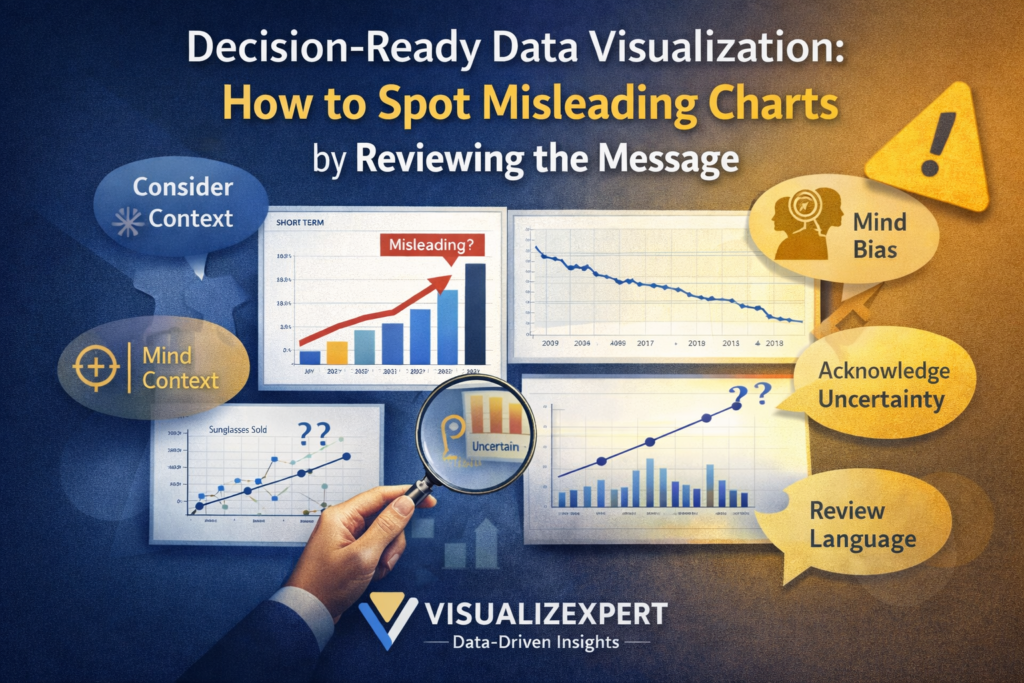
    In an era where charts influence everything from executive decisions to public opinion, decision-ready data visualization has never been more important. Charts simplify complexity, highlight patterns, and help us act quickly—but they can also mislead if the message behind them is misunderstood or intentionally distorted.

    At VisualizExpert, a data analytics agency delivering advanced data analytics services, we help organizations move beyond surface-level visuals toward trustworthy insights. Spotting misleading charts is not about distrusting data—it’s about understanding the author’s interpretation, assumptions, and framing.

    This article focuses on one of the most critical yet overlooked skills in analytics: reviewing the message behind a chart so leaders can make confident, informed decisions.


    Why Charts Can Mislead Even When the Data Is Correct

    Many people assume misleading charts are the result of bad data. In reality, even accurate data can be misinterpreted through selective comparisons, missing context, or emotionally loaded language.

    Charts are flexible communication tools, much like written language. Just as words can persuade or manipulate, visuals can emphasize certain narratives while downplaying others. This is why strong business intelligence consulting emphasizes not just technical accuracy, but interpretive integrity.

    Without this skill, even sophisticated BI dashboard solutions risk becoming vehicles for misinformation instead of insight.


    Decision-Ready Data Visualization Requires Critical Interpretation

    Decision-Ready Data Visualization Starts With Asking “Compared to What?”

    One of the most common causes of misleading messages is incomplete comparison. Charts rarely speak in absolutes—they rely on context.

    A chart may show an increase, decrease, or difference, but compared to what baseline? A single time period, product category, or region can completely alter the takeaway. Without understanding the comparison being made, viewers may draw conclusions that the data does not support.

    This is why analytics and reporting consulting frameworks emphasize comparative clarity. Decision-ready visuals ensure that comparisons answer the right business question, not just a convenient one.


    Context Is the Difference Between Insight and Misinformation

    Charts that isolate a narrow slice of data often imply trends that disappear when broader context is added. A short-term spike may look alarming, while a long-term view shows stability or improvement.

    At VisualizExpert, we frequently encounter dashboards that unintentionally mislead because they lack historical or categorical context. This is especially common in executive analytics dashboards, where limited space can lead to oversimplification.

    Good context doesn’t clutter a visual—it strengthens trust.


    Correlation Is Not Causation: A Classic Misinterpretation

    Even when charts are well-designed, interpretations can go wrong when correlation is mistaken for causation.

    Two metrics moving together does not mean one causes the other. External factors often influence both. Without careful interpretation, leaders may invest resources in solving the wrong problem.

    This is why strong data visualization services focus on explanation, not just presentation. Visuals should invite thoughtful interpretation rather than encourage quick, unsupported conclusions.


    Why Uncertainty Must Be Part of the Message

    Data is never perfect. Surveys, forecasts, and samples all contain uncertainty. Ignoring this uncertainty creates false confidence.

    Margins of error, confidence intervals, and sample size context are not signs of weak data—they are signs of honest analysis. When uncertainty is hidden, viewers may believe differences are meaningful when they are not.

    In enterprise data visualization, acknowledging uncertainty is essential for ethical decision-making. Leaders should understand not only what the data suggests, but how confident they can be in that suggestion.


    Language Shapes How Charts Are Understood

    Words matter as much as visuals.

    Titles, subtitles, labels, and annotations frame how viewers interpret a chart. Emotionally charged language can exaggerate urgency or downplay risk. Poorly chosen terminology can also reinforce bias or dehumanize the subjects represented in the data.

    At VisualizExpert, our data storytelling services emphasize inclusive, neutral, and precise language. The goal is clarity—not persuasion.

    A chart should describe what the data shows, not what the author wants the audience to believe.


    Bias Can Exist Even Without Bad Intent

    Not all misleading charts are intentionally deceptive. Many are created by well-meaning analysts who lack training in data literacy or equity-aware design.

    Bias can appear through:

    • Metric selection
    • Data exclusions
    • Framing of results
    • Cultural assumptions

    This is why visual analytics consulting plays a critical role in modern organizations. A second set of expert eyes often reveals blind spots that creators themselves cannot see.


    From Charts to Dashboards: Scaling Trust Across the Organization

    Misinterpretation doesn’t stop at individual charts—it compounds across dashboards.

    A single misleading visual replicated across interactive business dashboards can shape strategy, budgets, and performance reviews. Over time, this erodes trust in analytics altogether.

    Organizations investing in Power BI dashboards or modern BI platforms must pair tooling with education. Governance, review processes, and shared standards are essential for consistent interpretation.


    How VisualizExpert Helps Build Decision-Ready Visualization

    As a specialized data analytics agency, VisualizExpert helps organizations design analytics that leaders can trust.

    Our approach combines:

    • Custom analytics solutions aligned with real decisions
    • KPI dashboard services grounded in business outcomes
    • Executive summary dashboards that prioritize clarity over complexity
    • Decision-ready data visualization principles applied across reports and dashboards

    We don’t just ask whether a chart is accurate—we ask whether it leads to the right decision.


    Keep Asking Questions When You Read Charts

    Strong data literacy is a habit, not a checklist.

    When viewing any chart, ask:

    • What is being compared?
    • What context is missing?
    • How much uncertainty exists?
    • How does language influence interpretation?
    • Who benefits from this framing?

    These questions turn passive viewers into active decision-makers.


    Practice Builds Confidence

    Interpreting charts is a skill that improves with practice. The more charts you evaluate critically, the easier it becomes to spot misleading messages.

    Organizations that invest in data driven decision making empower employees at every level—not just analysts—to challenge assumptions and improve outcomes.


    Shared Interpretation Strengthens Organizations

    Analytics should never exist in isolation. Discussing charts with peers often reveals alternative interpretations and hidden assumptions.

    This collaborative review process strengthens organizational decision-making and reduces the spread of misinformation. It also builds a shared data culture where questions are encouraged—not avoided.


    Final Thoughts

    Charts are powerful tools—but power requires responsibility.

    Decision-ready data visualization is not about making charts more impressive. It’s about making decisions more informed, fair, and defensible.

    When leaders learn to review the message behind charts, they move from reacting to visuals to reasoning with evidence.

    At VisualizExpert, that shift—from data to decisions—is where real value begins.

  • Power BI Reports vs Dashboards: A Practical Guide for Teams Migrating from Tableau


    Introduction

    If you’ve recently transitioned from Tableau to Power BI, you’ve likely asked the same question many teams do: “Where are the dashboards?” The confusion is understandable. While Power BI dashboards and Tableau dashboards sound similar, they are designed for very different purposes.

    At VisualizExpert, a data analytics agency delivering end-to-end data analytics services, we frequently support organizations navigating this transition as part of broader business intelligence consulting engagements. Understanding the difference between reports and dashboards in Power BI is essential for building analytics that executives trust and teams actually use.

    This guide explains how Power BI reports vs dashboards differ, why the distinction matters, and how organizations can design scalable analytics when migrating from Tableau.


    What Is a Power BI Report?

    A Power BI report is created in Power BI Desktop and acts as the core analytical workspace. Reports are interactive, flexible, and designed for exploration.

    Reports can include multiple pages, each with different visualizations, slicers, and filters. All visuals within a report must connect to a single semantic model, which makes Power BI data modeling a critical success factor. When modeling is done correctly — often through dedicated Power BI Data Modeling Services — reports become fast, reliable, and easy to understand.

    Reports are where teams answer questions like why did this happen or what changed. They are essential for analysts, finance teams, operations managers, and anyone responsible for detailed analysis.


    Power BI Reports vs Dashboards: Understanding the Core Difference

    Power BI Reports vs Dashboards in Practice

    The most important distinction is where these assets live and how they are used.

    Reports are built in Power BI Desktop and can be published to the Power BI service. Dashboards, however, exist only in the Power BI service. A dashboard is a single-page canvas created by pinning visuals from one or multiple reports.

    This difference changes how users interact with data. Reports are designed for deep exploration. Dashboards are designed for monitoring and decision-making.

    At VisualizExpert, we design dashboards as decision interfaces, not visual collections. This approach aligns with our KPI dashboard services, where every visual exists to support a specific business outcome.


    Why Power BI Dashboards Are Built for Executives

    Executives rarely need full interactivity. What they need is clarity.

    A well-designed executive analytics dashboard answers high-level questions quickly:

    • Are we on track?
    • Where do we need to intervene?
    • Which metric signals risk or opportunity?

    Dashboards work best when paired with Power BI scorecards and consistent Power BI KPI tracking, allowing leadership to monitor progress without digging through report pages.

    To maintain trust, dashboards must rely on optimized calculations. This is where DAX Formula Optimization and standardized metrics play a crucial role.


    Designing Effective Power BI Dashboards

    Creating effective dashboards requires more than pinning charts.

    Strong dashboards follow a few essential principles:

    • KPIs are aligned with business goals through structured KPI strategy consulting
    • Metrics are standardized across reports and departments
    • Performance is optimized, especially when using live connections and Power BI DirectQuery Performance
    • Access is controlled using Power BI Row Level Security, ensuring the right users see the right data

    These practices ensure dashboards remain fast, accurate, and trusted as organizations scale.


    From Tableau to Power BI: What Changes for Users

    Teams coming from Tableau often expect dashboards in Power BI to behave the same way. This is one of the biggest sources of frustration during migration.

    In Tableau, dashboards are highly interactive and often serve both analytical and executive purposes. In Power BI, that responsibility is split. Reports handle analysis, while dashboards focus on monitoring and alignment.

    Organizations with strong experience in Tableau Dashboard Design typically adapt quickly once they understand this separation. The key is redesigning — not recreating — existing analytics.

    This is where experienced Power BI consulting services add value by translating Tableau logic into Power BI’s architecture.


    Common Mistakes During Migration

    Across many Power BI migration projects, a few mistakes appear consistently.

    Teams often try to rebuild Tableau dashboards directly as Power BI dashboards instead of reports. Others skip proper Power BI Star Schema Design, leading to slow visuals and inconsistent KPIs. Some overload dashboards with operational detail, making them unusable for leadership.

    Successful migrations focus on clarity, governance, and long-term usability — not visual parity.


    Reports for Teams, Dashboards for Decisions

    A useful way to think about Power BI assets is this:

    Reports help teams understand why something happened. Dashboards help leaders decide what to do next.

    This separation allows organizations to scale analytics across departments while keeping leadership focused on outcomes. It also enables advanced scenarios like Power BI Embedded Analytics, where dashboards are surfaced inside internal tools or customer-facing applications.


    How VisualizExpert Supports Power BI Success

    As a specialized data analytics agency, VisualizExpert helps organizations design analytics that drive real decisions.

    Our services include:

    • Custom Power BI reports for operational and analytical teams
    • BI dashboard solutions tailored for executives
    • Analytics and reporting consulting to align metrics with strategy
    • Power BI Managed Services to maintain performance, security, and adoption

    We combine data visualization services with a deep understanding of business context to build interactive business dashboards that leadership actually trusts.


    When to Use Dashboards vs Reports

    Reports are best when users need exploration, comparisons, and detailed analysis. Dashboards are best when leaders need fast insight, trend monitoring, and alignment.

    Organizations that succeed with Power BI design both intentionally and never try to make one do the job of the other.


    Final Thoughts

    Understanding the difference between Power BI reports vs dashboards is not just a technical lesson. It’s a strategic shift.

    When reports and dashboards are designed around real decisions, adoption improves, trust increases, and analytics deliver measurable ROI.

    If your organization is migrating from Tableau or rethinking its BI foundation, aligning analytics with decision-making is the most impactful place to start.

    At VisualizExpert, that’s exactly what we help organizations achieve.

  • Strategic BI Roadmap Development: How to Build a Data Strategy That Gets Adopted

    Introduction

    Many organizations invest heavily in analytics tools, platforms, and data teams — yet still struggle to turn data strategy into consistent execution. The missing link is rarely technology. It’s adoption. This is exactly where Strategic BI Roadmap Development becomes critical.

    A well-designed BI roadmap translates ambition into action. It connects business priorities to sequenced initiatives, sets realistic expectations, and aligns teams around shared outcomes. Most importantly, it becomes a living operating plan that leaders rely on and departments actually follow.

    At VisualizExpert, we’ve seen firsthand that roadmaps don’t fail because they’re incomplete — they fail because they aren’t designed for how organizations make decisions. This article breaks down how to build a BI roadmap that earns trust, survives change, and gets adopted across the enterprise.

    What Is a BI Roadmap — and Why Adoption Matters

    A BI roadmap is not a project plan or a list of technologies. It is a structured, time-bound view of what data capabilities will be delivered, when they will arrive, and why they matter to the business.

    When done correctly, a roadmap clarifies:

    • What insights the business will gain
    • How success will be measured
    • Which initiatives are foundational versus additive
    • Where trade-offs must be made

    Without this clarity, analytics efforts drift. Teams chase urgent requests, executives fund disconnected initiatives, and data leaders are left defending priorities instead of executing them.

    Adoption is the difference between a roadmap that lives in a slide deck and one that shapes daily decisions.

    When Organizations Should Build a BI Roadmap

    A BI roadmap should be created after strategy discovery and use-case prioritization — not before. It is the final step that turns intent into execution.

    Common triggers include:

    • Rapid growth creating reporting inconsistency
    • Leadership demanding clearer ROI from data investments
    • Expanding analytics or AI initiatives without governance
    • Platform migrations or modernization efforts
    • Increasing friction between central data teams and department

    In each case, the roadmap becomes the shared source of truth that prevents analytics from becoming reactive and fragmented.

    How Strategic BI Roadmap Development Drives Organization-Wide Adoption

    Adoption doesn’t happen through mandate — it happens through relevance, clarity, and trust. Strategic BI Roadmap Development focuses on these three levers.

    1. Make the Roadmap a Decision Tool for Executives

    Executives don’t approve dashboards or data platforms — they approve outcomes.

    For leadership, the roadmap must:

    • Tie initiatives directly to business KPIs and OKRs
    • Make sequencing and trade-offs explicit
    • Show when value will materialize, not just when work starts

    Rather than debating every new request in isolation, leaders use the roadmap to guide funding decisions. This shifts conversations from “why do you need this?” to “what moves if we prioritize this now?”

    The result is alignment — not micromanagement.

    2. Use the Roadmap as a Shared Timeline for Departments

    Departments don’t adopt strategies they can’t see themselves in.

    For managers and operational leaders, the roadmap answers:

    • What will my team receive?
    • When will it be usable?
    • What input is required from us?

    Clear deliverables — such as executive dashboards, operational reports, or analytics models — build confidence that requests aren’t disappearing into a backlog. Transparent sequencing explains why certain teams are served first and how shared foundations benefit everyone.

    This visibility transforms departments from passive recipients into active participants in the data strategy.

    3. Make People and Capacity Explicit

    One of the most common causes of roadmap failure is ignoring execution capacity.

    A credible BI roadmap must surface:

    • Required roles and skills
    • Capacity constraints and dependencies
    • Where hiring, reskilling, or external support is necessary

    Analytics initiatives don’t fail because ideas are bad — they fail because teams are stretched thin. By making staffing and ownership visible, the roadmap prevents burnout and sets realistic expectations.

    This also strengthens trust: leaders can see what it actually takes to deliver value.

    4. Treat the Roadmap as a Living Operating Plan

    A roadmap that doesn’t evolve quickly becomes irrelevant.

    Quarterly reviews ensure the roadmap remains aligned with:

    • Shifting business priorities
    • New regulatory or market pressures
    • Emerging opportunities such as AI or automation
    • Organizational capacity and maturity

    These reviews should focus on impact, not activity. Reporting value delivered, adoption levels, and upcoming risks reinforces confidence that the roadmap is working.

    Change isn’t a failure of planning — it’s a reality of business. The roadmap’s job is to absorb change without losing direction.

    What an Effective BI Roadmap Review Looks Like

    To maintain momentum, roadmap reviews should answer five questions:

    1. What value has been delivered so far?
      Quantify impact in terms of revenue, cost reduction, time saved, or decisions accelerated.
    2. Who is actually using what we built?
      Adoption metrics validate relevance and surface where enablement is needed.
    3. What priorities need to shift — and why?
      Transparent re-prioritization builds credibility and prevents political escalation.
    4. Where are we constrained?
      Identifying skills or capacity gaps early avoids stalled initiatives.
    5. How does this still align with business objectives?
      Re-anchoring to outcomes ensures foundational work is understood, not dismissed.

    This structure turns reviews into strategic conversations — not status updates.

    Why Most BI Roadmaps Fail (and How to Avoid It)

    Roadmaps typically fail for three reasons:

    • They are built as technology plans instead of business plans
    • They lack ownership and executive sponsorship
    • They are treated as static documents

    Avoiding these pitfalls requires discipline. Roadmaps must be outcome-driven, championed at the executive level, and continuously reinforced through communication and delivery.

    At VisualizExpert, roadmaps are designed to survive real-world complexity — not ideal conditions.

    The VisualizExpert Approach

    VisualizExpert approaches BI roadmaps as adoption frameworks, not documentation exercises.

    Every roadmap is built to:

    • Align analytics initiatives with business strategy
    • Make trade-offs visible and defensible
    • Support decision-making at every level
    • Evolve as the organization grows

    This approach reflects deep experience across industries and analytics maturity levels — ensuring roadmaps are both ambitious and executable.

    Key Takeaways

    • A BI roadmap turns strategy into action by clarifying what gets delivered, when, and why it matters.
    • Adoption depends on relevance to executives, departments, and delivery teams.
    • People and capacity are as critical as platforms and tools.
    • Regular reviews keep the roadmap credible, aligned, and trusted.
    • Strategic BI Roadmap Development is not a one-time exercise — it’s an ongoing operating discipline.

    Build a Data Strategy Roadmap That Actually Gets Used
    Talk with a VisualizExpert data analytics expert to review your current roadmap, identify adoption gaps, and align your data initiatives with measurable business outcomes.

  • Power BI Dashboard Development: Building Biggest Movers Charts for Decision-Ready Analytics

    Introduction

    In modern analytics environments, knowing what changed matters just as much as knowing what happened. This is where Power BI Dashboard Development becomes essential. Instead of overwhelming stakeholders with static reports or disconnected KPIs, well-designed dashboards surface meaningful movement in data — especially period-over-period changes that demand attention.

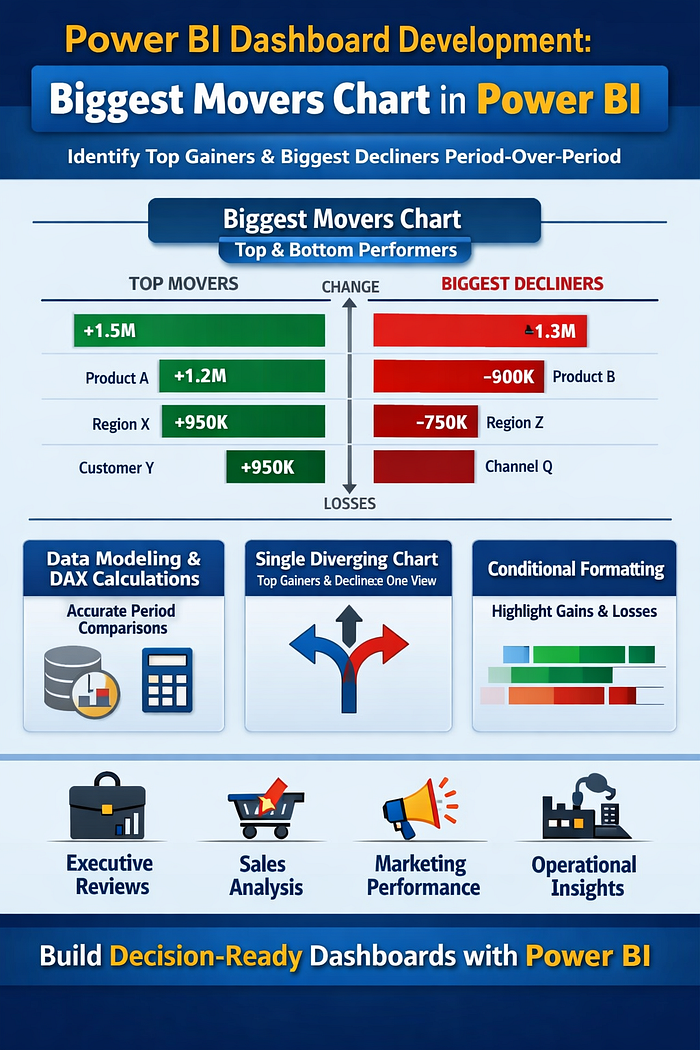
    One of the most effective ways to achieve this is through a Biggest Movers Chart. This visualization highlights the dimension members — products, regions, customers, or channels — that experienced the largest positive or negative change over time. Rather than scanning multiple visuals to find gains and losses, decision-makers can instantly understand impact in a single view.

    At VisualizExpert, dashboards are not built to impress — they are built to answer questions. In this article, we’ll explore how biggest movers charts fit into practical Power BI dashboards, why they outperform traditional visuals, and how expert dashboard development transforms raw change data into actionable insight.

    Why Biggest Movers Charts Matter in Business Intelligence

    Most dashboards focus on totals, averages, or rankings. While useful, these metrics often hide volatility. A product might still be a top seller, yet declining rapidly. A region may show modest revenue but improving faster than any other.

    Biggest movers charts solve this problem by focusing on change, not just size.

    Key benefits include:

    • Immediate visibility into rising and declining performers
    • Faster identification of risks and opportunities
    • Reduced cognitive load compared to multiple top/bottom visuals
    • Clear prioritization for leadership discussions

    Instead of asking, “What are our top products?”, teams can ask, “What changed the most — and why?”

    How Power BI Dashboard Development Enables Biggest Movers Analysis

    Effective biggest movers visuals don’t happen by accident. They require thoughtful modeling, precise calculations, and strong visual design — core pillars of Power BI Dashboard Development.

    1. Data Modeling That Supports Time Comparisons

    Before any chart is created, the underlying data model must support accurate period-over-period analysis. This means:

    • A clean date table
    • Consistent granularity across fact tables
    • Clearly defined relationships

    Without this foundation, movement calculations become unreliable. At VisualizExpert, dashboard projects always begin with data structure validation to ensure every visual reflects reality.

    2. Calculating Absolute Change Correctly

    Biggest movers charts typically rank dimension members by absolute change, not percentage alone. This ensures that both large gains and large losses are surfaced — even if they move in opposite directions.

    For example:

    • Product A: +₹1.2M increase
    • Product B: −₹900K decrease

    A well-designed biggest movers chart displays both together, allowing immediate comparison.

    This analytical clarity is what separates dashboards built for reporting from dashboards built for decisions.

    3. Designing a Single Visual for Positive and Negative Movement

    Traditionally, analysts create two visuals: top movers and bottom movers. This fragments insight.

    A single biggest movers chart:

    • Uses a diverging axis
    • Clearly separates positive and negative change
    • Maintains consistent sorting logic

    This design choice reduces noise and speeds up comprehension — especially in executive dashboards where time is limited.

    Conditional Formatting: Turning Insight into Intuition

    Numbers alone don’t drive action — clarity does. Conditional formatting enhances biggest movers charts by visually encoding meaning.

    Common approaches include:

    • Color gradients for positive vs. negative change
    • Emphasis on extreme outliers
    • Muted tones for low-impact movement

    When implemented correctly, stakeholders can understand performance direction without reading a single label.

    At VisualizExpert, formatting choices are guided by business context, not aesthetics alone. The goal is always to reduce interpretation effort.

    Use Cases Where Biggest Movers Charts Deliver the Most Value

    Biggest movers charts are not generic visuals — they shine in specific business scenarios:

    Executive Performance Reviews

    Leaders don’t need every KPI — they need to know what shifted. Biggest movers visuals surface the drivers behind results, enabling sharper strategic conversations.

    Sales and Revenue Monitoring

    Sales teams can instantly see which products, regions, or accounts are accelerating or declining, without digging through tables.

    Marketing Campaign Analysis

    Instead of focusing only on top channels, teams can identify which campaigns changed performance the most between periods.

    Operations and Supply Chain

    Movement-based visuals help detect sudden drops in efficiency, fulfillment delays, or cost spikes before they become systemic issues.

    Common Mistakes to Avoid

    Even experienced Power BI users can dilute the value of biggest movers charts. The most common pitfalls include:

    • Ranking by percentage change without context
    • Mixing different time comparisons in the same visual
    • Overloading the chart with too many dimension members
    • Ignoring negative movement

    Strong Power BI Dashboard Development avoids these issues by aligning visuals with decision intent — not technical convenience.

    How VisualizExpert Approaches Dashboard Design

    VisualizExpert doesn’t treat dashboards as templates. Every project begins with three core questions:

    1. What decision should this dashboard support?
    2. What movement in data signals risk or opportunity?
    3. How fast should that signal be understood?

    Biggest movers charts are used strategically — only where change matters more than totals. Combined with thoughtful layout, narrative flow, and performance optimization, these visuals become powerful tools for leadership alignment.

    This approach reflects EEAT principles:

    • Experience: Built from real-world dashboard implementations
    • Expertise: Grounded in advanced Power BI practices
    • Authority: Designed for executive and operational decision-makers
    • Trust: Transparent calculations and consistent logic

    Answering the Question Decision-Makers Actually Ask

    Many executives don’t ask, “What does the data say?”
    They ask, “What changed — and what should we do?”

    Biggest movers charts answer that question directly.

    When embedded into a thoughtfully designed Power BI dashboard, they eliminate guesswork, shorten meetings, and align teams around facts that matter.

    Final Thoughts

    Data visibility alone doesn’t create impact. Insight comes from understanding movement, direction, and magnitude — quickly and clearly.

    That is the real value of Power BI Dashboard Development done right.

    At VisualizExpert, dashboards are built to surface change, not hide it. Biggest movers charts are just one example of how analytics can move beyond reporting and become a decision engine for modern businesses.

    If your dashboards still tell you what happened but not what changed, it may be time to rethink how your analytics are designed.

  • Strategic BI Roadmap Development: Charting a Smarter Data Strategy for 2026

    Strategic BI Roadmap Development is becoming one of the most critical capabilities for organizations heading into 2026. As data volumes grow and analytics tools multiply, many businesses find themselves surrounded by dashboards but still unsure how to move forward with confidence. Reports exist, metrics exist—but clarity does not.

    At VisualizExpert, we see this challenge across industries and growth stages. The problem isn’t a lack of data or technology. It’s the absence of a shared strategy that connects analytics efforts to real business decisions. A roadmap brings structure, alignment, and intent to an otherwise fragmented analytics landscape.


    Why Modern Data Initiatives Lose Momentum

    Most organizations don’t start their analytics journey incorrectly. They invest in tools, hire analysts, and build dashboards with good intentions. The breakdown happens later—when growth introduces complexity.

    Common signs include:

    • Multiple teams answering the same question differently
    • Analytics teams stuck responding to ad-hoc requests
    • Leadership unsure which numbers to trust
    • Reporting that explains the past but doesn’t guide action

    Without a clear strategy, analytics becomes reactive. Teams work hard, but progress feels scattered. A roadmap is what turns effort into direction.


    What a BI Roadmap Actually Solves

    A BI roadmap is not a project plan or a tool checklist. It is a strategic framework that connects business goals, data capabilities, and execution priorities.

    When done well, a roadmap helps organizations:

    • Clarify what decisions matter most
    • Identify gaps across people, process, and technology
    • Sequence initiatives realistically
    • Balance short-term wins with long-term scalability

    Instead of asking, “What should we build next?”, teams start asking, “What decision are we trying to improve?”


    Strategic BI Roadmap Development as a Structured Engagement

    Strategic BI Roadmap Development

    At VisualizExpert, roadmap engagements are designed to be collaborative, practical, and outcome-driven. Rather than prescribing generic solutions, we work closely with stakeholders to define a path that fits the organization’s current maturity and future ambitions.

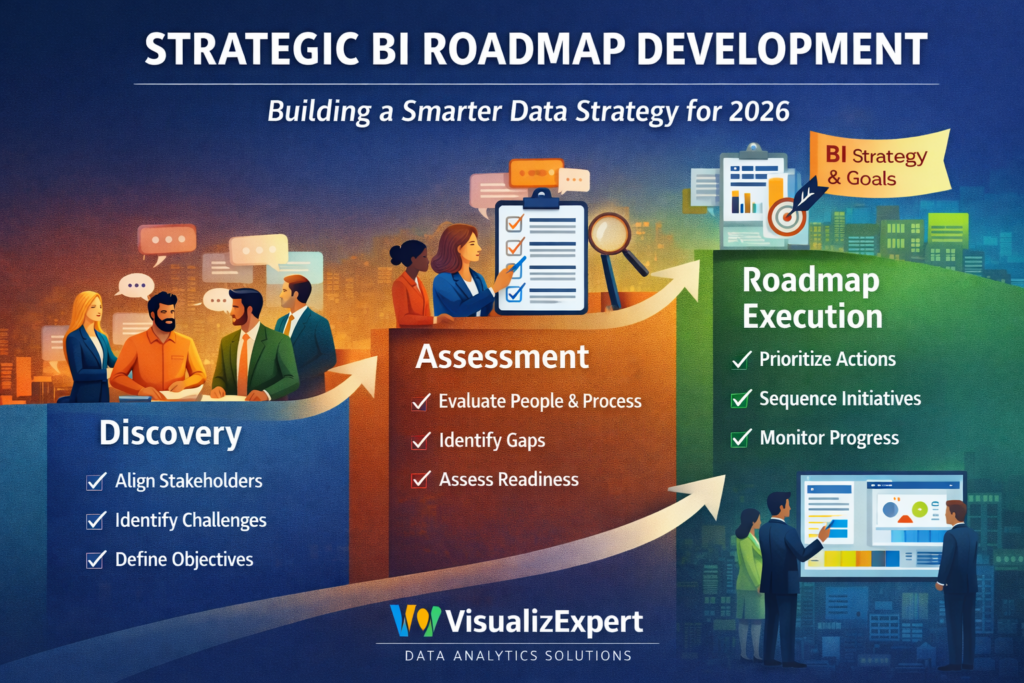
    The engagement typically unfolds across three connected phases.


    Phase 1: Discovery and Alignment

    The first step is creating shared understanding.

    This phase focuses on conversations—not dashboards. We bring together leaders, analysts, and operational teams to uncover:

    • Key decisions that drive outcomes
    • Current pain points and inefficiencies
    • Where ownership is unclear
    • What success actually looks like

    This alignment phase often surfaces a critical insight: teams are solving real problems, but in isolation. A roadmap aligns those efforts into a single direction.


    Phase 2: Capability and Maturity Assessment

    Once goals are clear, the next step is understanding readiness.

    This phase examines:

    • How data flows today
    • How insights are created and consumed
    • Where friction, rework, or delays occur
    • Whether current practices support future goals

    Rather than focusing only on tools, this assessment looks at how analytics operates as a system. The outcome is a clear picture of what’s enabling progress—and what’s silently slowing it down.


    Phase 3: A Prioritized Execution Roadmap

    The final output is a clear, phased roadmap that connects today’s reality to tomorrow’s goals.

    This roadmap:

    • Defines what to do first, and what can wait
    • Highlights dependencies and sequencing
    • Sets realistic expectations around effort and impact
    • Creates accountability without rigidity

    Importantly, the roadmap is actionable whether teams execute independently or with continued support. It becomes a decision-making reference, not a static document.


    Why Leadership Engagement Improves with a Roadmap

    One of the most consistent outcomes of roadmap engagements is stronger leadership alignment.

    Executives gain:

    • Visibility into current-state challenges
    • Context for prioritizing analytics investments
    • Confidence that initiatives are connected—not random
    • A shared language for discussing data strategy

    Instead of approving isolated requests, leadership evaluates analytics as a coordinated portfolio of initiatives aligned to business value.


    Supporting Modernization Without Creating Chaos

    Many organizations pursue roadmaps while preparing for major transitions—cloud adoption, platform changes, or advanced analytics initiatives. Without structure, these efforts can create disruption instead of progress.

    A roadmap helps organizations modernize with intent:

    • Foundations are strengthened before complexity increases
    • Experiments are guided, not scattered
    • Risks are identified early, not after failure

    This approach allows organizations to evolve their data capabilities without overwhelming teams or losing trust.


    Governance That Enables, Not Restricts

    Governance often gets delayed because it’s perceived as restrictive. In reality, governance becomes far easier when embedded within a strategy.

    A roadmap reframes governance as:

    • Clear ownership instead of control
    • Consistent definitions instead of bureaucracy
    • Responsible access instead of blanket restrictions

    This balance supports scale, trust, and compliance simultaneously.


    Culture and Adoption Matter More Than Tools

    Analytics success is ultimately a human challenge.

    A strong roadmap considers:

    • How teams learn to work with data
    • How insights are communicated
    • How decisions are reinforced and measured

    By addressing adoption and literacy alongside technical initiatives, organizations increase long-term ROI and reduce resistance to change.


    Why VisualizExpert

    VisualizExpert helps organizations move from reactive reporting to intentional analytics strategy. Our roadmap engagements are grounded in real-world experience across industries, growth stages, and analytics ecosystems.

    We don’t just help you plan—we help you think clearly about data, decisions, and execution.

    If your organization is heading into 2026 with growing data complexity and unclear priorities, a roadmap may be the most valuable analytics investment you make.

    Get expert guidance from VisualizExpert—and build a data strategy that actually moves the business forward.

  • Data Analytics Services That Help Enterprises Govern and Scale Tableau Cloud


    Data analytics services are no longer just about creating dashboards. As modern BI platforms like Tableau Cloud scale across departments, geographies, and thousands of users, the real challenge shifts to governance, observability, and trust.

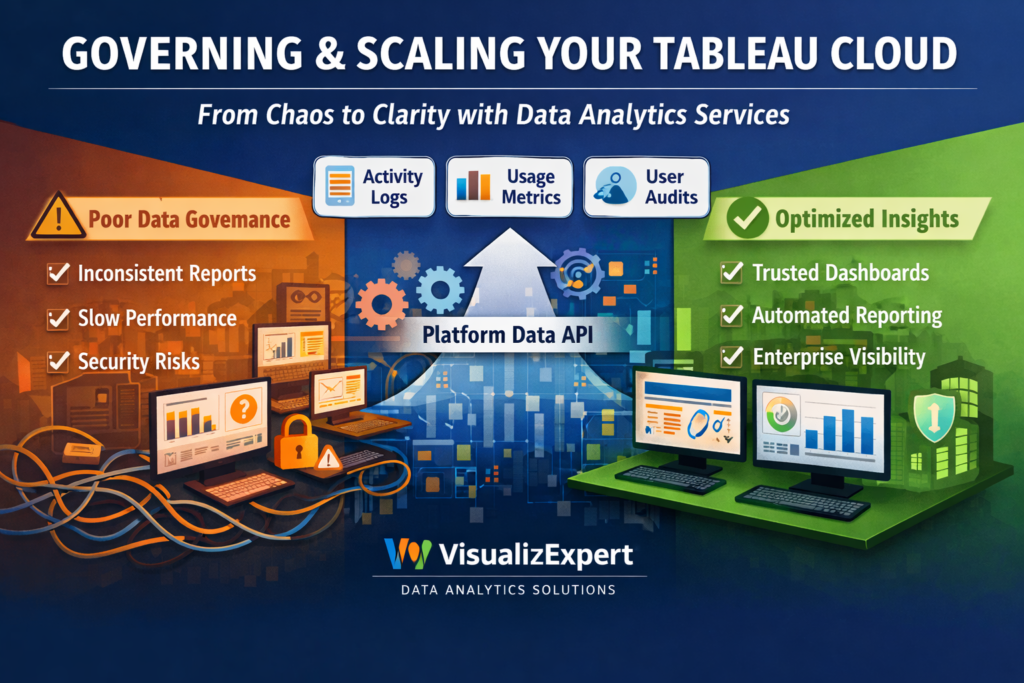
    In the first 100 days of growth, teams celebrate adoption. In the next 12 months, they struggle with performance issues, duplicated dashboards, inconsistent KPIs, and growing security concerns. This is exactly the gap Tableau’s Platform Data API addresses — and where VisualizExpert helps organizations turn raw platform data into actionable intelligence.


    Why BI Breaks at Scale (and Why Observability Matters)

    Most organizations underestimate how quickly BI environments become complex. As more users publish content, schedule extract refreshes, and query shared data sources, even well-designed dashboards can turn into operational blind spots.

    This is why business intelligence consulting today must go beyond visuals. Enterprises need visibility into how analytics platforms are being used — not just what they show.

    Business intelligence consulting

    At VisualizExpert, we work with BI leaders to design governance-first analytics strategies, combining platform telemetry with executive reporting so decisions are based on reality, not assumptions.


    From Self-Service to System-Level Intelligence

    Tableau’s Platform Data API introduces a critical shift: admins can now pull event-level data across sites, users, permissions, refreshes, and performance logs. But raw observability data alone isn’t enough.

    This is where custom analytics solutions become essential.

    Custom analytics solutions

    VisualizExpert transforms Tableau Cloud event data into curated insights — highlighting unused dashboards, slow-performing extracts, risky permission changes, and adoption patterns that impact ROI.


    KPI Design for Platform Health, Not Just Business Metrics

    Most BI teams track revenue, pipeline, or marketing KPIs — but ignore the KPIs that keep analytics healthy. Without them, growth creates friction.

    KPI dashboard services

    We design KPI frameworks that monitor BI usage, content quality, refresh reliability, and user engagement — so leaders know whether their analytics ecosystem is strengthening or silently degrading.


    Designing Scalable Models Behind Observability Dashboards

    Platform data APIs generate high-volume, event-driven data. Without proper modeling, dashboards slow down and lose credibility.

    Power BI Star Schema Design

    When organizations consolidate Tableau observability data into Power BI or cloud warehouses, VisualizExpert applies star schema modeling to ensure fast queries, consistent metrics, and future-proof analytics.


    Embedded Observability for Admins and Leaders

    Admins shouldn’t need to export logs manually or switch tools to understand platform health.

    Power BI Embedded Analytics

    We embed observability dashboards directly into internal admin portals, making performance monitoring, audit readiness, and usage analysis accessible to the right stakeholders in real time.


    Visual Clarity Is Not Optional at Enterprise Scale

    When hundreds of users rely on dashboards daily, poor design creates misinterpretation — not insight.

    Data visualization services

    VisualizExpert applies enterprise visualization standards so observability dashboards surface risks, trends, and anomalies clearly — without overwhelming administrators or executives.


    Managing BI Platforms Is an Ongoing Responsibility

    Governance isn’t a one-time project. As Tableau environments evolve, so must monitoring and optimization.

    Power BI Managed Services

    Our managed services ensure observability dashboards stay accurate, data models remain optimized, and reporting adapts as Tableau Cloud features expand.


    Turning Platform Data into Leadership-Ready Views

    Executives don’t want logs — they want answers.

    BI dashboard solutions

    We translate technical platform data into leadership-friendly dashboards that explain adoption ROI, cost efficiency, risk exposure, and analytics maturity.


    Interactive Monitoring for Faster Decisions

    Static admin reports don’t scale.

    Interactive business dashboards

    VisualizExpert builds interactive dashboards that allow admins to drill from global platform health into site-level or user-level events within seconds.


    Enterprise Governance Requires Enterprise-Grade Design

    Large organizations need more than functional dashboards — they need confidence.

    Enterprise data visualization

    We apply enterprise visualization principles that support auditability, compliance, and clarity across complex Tableau Cloud deployments.


    Executive Views That Align BI With Strategy

    Analytics leaders must justify investments and adoption.

    Executive analytics dashboards

    Our executive dashboards connect platform usage data to business outcomes — helping leaders understand how analytics supports growth, not just reporting.


    Modeling Matters More Than Tools

    Without strong modeling, even the best APIs fail.

    Power BI Data Modeling Services

    We design scalable data models that integrate Tableau Platform Data API outputs with cloud warehouses, identity systems, and cost data.


    Moving Teams Off Spreadsheet-Based Monitoring

    Manual tracking doesn’t survive scale.

    Power BI Migration from Excel

    VisualizExpert helps BI teams migrate ad-hoc Excel-based admin tracking into automated, governed dashboards with historical context.


    Tableau Expertise Still Matters

    Observability doesn’t replace design — it enhances it.

    Tableau Dashboard Design

    We redesign Tableau dashboards using usage insights from the Platform Data API — removing unused content and optimizing high-impact views.


    Consulting That Connects Tools, Data, and Decisions

    Technology alone doesn’t fix governance gaps.

    Power BI consulting services

    Our consultants align Tableau, Power BI, and cloud data strategies into one coherent analytics operating model.


    Reports Should Be Built for Decisions, Not Downloads

    Automation changes everything.

    Custom Power BI reports

    We build automated reports that surface exceptions, risks, and trends — so admins act before problems escalate.


    Advanced Tableau Calculations Still Have a Role

    Some insights require deep Tableau expertise.

    Tableau LOD Calculation Expert

    VisualizExpert applies LOD calculations to analyze user behavior, content performance, and site-level trends accurately.


    Performance Is a Governance Issue

    Slow dashboards reduce trust.

    Tableau Server Optimization

    Using observability data, we identify performance bottlenecks and optimize Tableau environments proactively.


    Finance Teams Need Analytics They Can Rely On

    Governance directly impacts financial confidence.

    Tableau for Finance Dashboards

    We help finance teams monitor data freshness, access controls, and reporting reliability — reducing operational risk.


    Supporting Teams Beyond Initial Deployment

    BI maturity is a journey.

    Tableau Desktop Developer Services

    Our developers support ongoing enhancements, refactoring, and optimization as Tableau usage evolves.


    Why VisualizExpert

    VisualizExpert doesn’t just build dashboards — we design analytics systems that scale. By combining Tableau’s Platform Data API with enterprise-grade modeling, visualization, and governance expertise, we help organizations move from reactive BI firefighting to proactive, decision-ready analytics.

    If your Tableau Cloud deployment is growing, your observability strategy needs to grow with it.

    Get expert guidance from VisualizExpert — and build BI that stays valuable at scale.

  • Power BI Dashboard Development: From Raw Data to Decision-Ready Intelligence

    Introduction: Why Power BI Dashboards Still Fail Without Context

    Note: image is created by the author, Parul Pandey

    Power BI Dashboard Development has become a default investment for organizations trying to become data-driven. Yet, despite powerful tools and growing data volumes, many dashboards fail to influence real decisions. Executives log in, scroll through charts, and still ask the same question: “So what should we do next?”

    At VisualizExpert, we see this pattern repeatedly. The issue is not Power BI itself — it’s how dashboards are conceptualized, modeled, and aligned to decision workflows. A dashboard is not a reporting artifact; it is a decision interface. When built correctly, it shortens the gap between insight and action. When built poorly, it becomes digital clutter.

    This article explores how modern Power BI dashboards should be designed — not as collections of visuals, but as strategic systems that support faster, clearer, and more confident business decisions.

    Power BI Dashboard Development as a Decision System (Not a Reporting Tool)

    Most dashboards start with data availability instead of business intent. Teams ask, “What data do we have?” instead of “What decisions need to be made?” This reversal is the root cause of dashboard overload.

    At VisualizExpert, our Power BI approach starts with decision mapping:

    • What decisions are made daily, weekly, and quarterly?
    • Who makes them?
    • What signals reduce uncertainty at that moment?

    Only after answering these questions do we design the dashboard structure.

    A well-built Power BI dashboard does three things:

    1. Frames the decision clearly
    2. Surfaces only the metrics that influence that decision
    3. Provides context for action (trend, benchmark, threshold)

    Anything beyond that is noise.

    The Architecture Behind Scalable Dashboards

    Great dashboards are invisible when done right. Users don’t think about filters, measures, or models — they think about outcomes. That experience is driven by strong backend design.

    At VisualizExpert, our architecture principles include:

    • Clean semantic models that mirror business logic
    • Separation of raw data, transformations, and measures
    • Consistent metric definitions across teams
    • Performance-optimized models that scale with data growth

    This foundation ensures dashboards remain fast, trusted, and extensible as the organization grows.

    Why “More Charts” Reduces Trust

    A common misconception is that adding more visuals adds value. In reality, excessive visuals reduce trust and slow decision-making.

    High-impact dashboards focus on:

    • A clear narrative flow
    • Progressive disclosure (summary → detail)
    • Visual hierarchy that guides attention
    • Minimal but meaningful interactivity

    Executives should understand the story in under 30 seconds. Analysts should be able to drill deeper without breaking context. This balance is intentional — and engineered.

    Power BI Dashboards for Executives vs. Operators

    Not all users consume data the same way.

    Executive dashboards prioritize:

    • Trends over transactions
    • Exceptions over completeness
    • Comparisons against targets

    Operational dashboards focus on:

    • Real-time or near-real-time monitoring
    • Process bottlenecks
    • Task-level accountability

    Trying to serve both audiences with a single dashboard leads to compromise. VisualizExpert designs role-specific views while maintaining a unified data model underneath — ensuring consistency without sacrificing usability.

    Trust Is Built Through Data Governance

    Even the most beautiful dashboard fails if users don’t trust the numbers.

    Trust is built when:

    • Metric definitions are documented and consisten
    • Data refresh cycles are transparent
    • Edge cases and limitations are acknowledged
    • Numbers reconcile with source systems

    VisualizExpert treats dashboards as products, not one-time deliverables. Governance, documentation, and ongoing optimization are part of the engagement — not an afterthought.

    From Descriptive to Predictive Thinking

    Modern analytics is moving beyond what happened toward what is likely to happen next. While Power BI is traditionally used for descriptive and diagnostic analytics, its real value emerges when paired with decision logic and predictive signals.

    Instead of static KPIs, effective dashboards:

    • Highlight early warning indicators
    • Compare current performance against expected patterns
    • Surface anomalies that require attention

    This shift transforms dashboards from passive reports into proactive decision companions.

    Why Adoption Matters More Than Features

    A technically perfect dashboard that no one uses has zero ROI.

    Adoption improves when dashboards:

    • Match how people actually work
    • Load quickly and behave predictably
    • Answer real questions, not hypothetical ones
    • Are introduced with context and training

    VisualizExpert measures success not by delivery, but by sustained usage. If a dashboard becomes part of weekly reviews and leadership conversations, it has done its job.

    The VisualizExpert Philosophy

    What differentiates VisualizExpert is not tool expertise alone — it’s perspective.

    We believe:

    • Dashboards should reduce cognitive load, not increase it
    • Metrics must align with strategy, not just availability
    • Design is a functional requirement, not decoration
    • Analytics maturity is built through clarity, not complexity

    Our dashboards are designed to be argued with, trusted, and acted upon.

    Conclusion: Dashboards That Change Decisions, Not Just Screens

    Power BI has democratized analytics — but dashboards alone don’t create insight. Insight emerges when data, design, and decision-making are treated as a single system.

    At VisualizExpertPower BI Dashboard Development is about building that system — where every metric has a purpose, every visual has intent, and every dashboard earns its place in the decision process.

    When dashboards are built this way, the question shifts from “What does the data say?” to “What should we do next?”
    And that is where analytics delivers real business value.

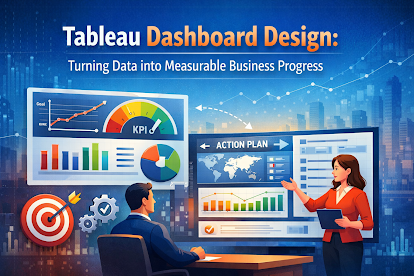
  • Tableau Dashboard Design: Turning Data into Measurable Business Progress

    Introduction: Why Dashboards Should Help You Achieve Goals

    Tableau Dashboard Design is often treated as a reporting exercise — something built at the end of a project to visualize numbers. In reality, dashboards are far more powerful when they are designed as goal-tracking and decision-support systems.

    Across organizations, leaders set ambitious targets: revenue growth, cost control, operational efficiency, customer retention. Yet many struggle to consistently track progress or understand why performance shifts. This gap is not caused by lack of data — it’s caused by dashboards that show activity instead of intent.

    At VisualizExpert, we design Tableau dashboards to help teams stay aligned, accountable, and focused on outcomes. Just like individuals use visual tracking to achieve personal goals, organizations need structured, interactive dashboards to achieve business goals — clearly, confidently, and continuously.

    Tableau Dashboard Design as a Goal-Driven Framework

    A dashboard should answer three fundamental questions:

    1. What is the goal?
    2. How are we performing against it?
    3. What action should follow?

    Many dashboards fail because they stop at the second question. They show performance but don’t guide action. Effective Tableau dashboards, on the other hand, are built around intentional metric selection and visual hierarchy.

    At VisualizExpert, every dashboard begins with a goal-mapping exercise:

    • Strategic goals (growth, profitability, efficiency)
    • Tactical objectives (campaign performance, conversion rates, fulfillment speed)
    • Operational signals (exceptions, bottlenecks, risks)

    Only metrics that influence decisions earn a place on the dashboard.

    Tracking Financial and Operational Performance with Clarity

    In business environments, financial and operational metrics are often scattered across spreadsheets, ERP systems, and reporting tools. Tableau dashboards unify these views into a single, trusted interface.

    A well-designed dashboard enables teams to:

    • Track revenue, margin, and cost trends over time
    • Compare actual performance against targets and forecasts
    • Identify early warning signs before issues escalate

    VisualizExpert emphasizes trend-based storytelling, not static totals. Leaders don’t need yesterday’s number alone — they need to understand direction, momentum, and deviation.

    Monitoring Performance Without Micromanagement

    One of the biggest challenges for leadership teams is balancing oversight with autonomy. Dashboards should create transparency without creating pressure.

    Effective Tableau dashboards:

    • Surface exceptions instead of every detail
    • Highlight where attention is required
    • Allow drill-downs without overwhelming users

    This design approach empowers teams to self-correct while giving leadership confidence that performance is being monitored intelligently.

    Interactive Dashboards That Encourage Exploration

    Static reports limit curiosity. Interactive dashboards encourage questions.

    When users can filter, compare, and explore data:

    • Engagement increases
    • Data literacy improves
    • Trust in analytics grows

    VisualizExpert designs interactivity with purpose. Filters, parameters, and actions are included only when they support exploration — not novelty. The result is a dashboard that feels intuitive, not intimidating.

    Building Data Literacy Through Tableau Dashboard Design

    One of the most overlooked benefits of strong dashboards is data literacy. Organizations often invest in analytics tools but underinvest in helping teams understand and interpret data.

    Thoughtfully designed dashboards help users:

    • Learn how metrics relate to each other
    • Understand cause-and-effect relationships
    • Develop confidence in data-driven discussions

    Instead of relying on analysts for every question, teams begin to engage directly with insights. This cultural shift — from reporting dependency to analytical independence — is where long-term value is created.

    Dashboards as Living Business Assets

    Dashboards should evolve as the business evolves.

    New goals, new markets, new strategies — all require dashboards to adapt. VisualizExpert treats dashboards as living assets, not static deliverables. This mindset ensures:

    • Metrics remain aligned with strategy
    • Definitions stay consistent over time
    • Dashboards scale with data complexity

    Regular reviews and refinement prevent dashboards from becoming outdated or ignored.

    Visual Storytelling for Stakeholder Alignment

    Executives, managers, and frontline teams consume data differently. A single dashboard must balance simplicity with depth.

    Strong visual storytelling:

    • Guides attention to what matters most
    • Uses visual contrast intentionally
    • Aligns layout with decision flow

    VisualizExpert designs dashboards that tell a story at a glance while still allowing deeper investigation when needed. This dual-layer approach ensures broad adoption across roles.

    From Personal Tracking to Enterprise Intelligence

    The same principles that help individuals track fitness or learning goals apply at an enterprise level:

    • Clear metrics
    • Consistent tracking
    • Visual feedback loops

    The difference lies in scale, governance, and impact. Enterprise dashboards influence budgets, strategy, and accountability. That responsibility demands rigor, clarity, and experience.

    VisualizExpert brings that discipline to every engagement — ensuring dashboards support not just insight, but execution.

    Why VisualizExpert’s Approach Works

    Our philosophy is simple:

    • Dashboards exist to reduce uncertainty
    • Metrics should drive action, not debate
    • Design must serve understanding, not decoration

    We combine analytical rigor with design thinking to ensure dashboards are trusted, used, and acted upon. The goal is not more dashboards — it’s better decisions.

    Conclusion: Dashboards That Help Organizations Move Forward

    Tableau is a powerful platform, but its real value depends on how dashboards are designed and used. When dashboards are built around goals, decisions, and users — not just data — they become catalysts for progress.

    At VisualizExpertTableau Dashboard Design is about helping organizations see clearly, act decisively, and stay aligned with what truly matters. Because the most successful businesses don’t just measure performance — they understand it.