Strategic BI Roadmap Development is becoming one of the most critical capabilities for organizations heading into 2026. As data volumes grow and analytics tools multiply, many businesses find themselves surrounded by dashboards but still unsure how to move forward with confidence. Reports exist, metrics exist—but clarity does not.
At VisualizExpert, we see this challenge across industries and growth stages. The problem isn’t a lack of data or technology. It’s the absence of a shared strategy that connects analytics efforts to real business decisions. A roadmap brings structure, alignment, and intent to an otherwise fragmented analytics landscape.
Why Modern Data Initiatives Lose Momentum
Most organizations don’t start their analytics journey incorrectly. They invest in tools, hire analysts, and build dashboards with good intentions. The breakdown happens later—when growth introduces complexity.
Common signs include:
- Multiple teams answering the same question differently
- Analytics teams stuck responding to ad-hoc requests
- Leadership unsure which numbers to trust
- Reporting that explains the past but doesn’t guide action
Without a clear strategy, analytics becomes reactive. Teams work hard, but progress feels scattered. A roadmap is what turns effort into direction.
What a BI Roadmap Actually Solves
A BI roadmap is not a project plan or a tool checklist. It is a strategic framework that connects business goals, data capabilities, and execution priorities.
When done well, a roadmap helps organizations:
- Clarify what decisions matter most
- Identify gaps across people, process, and technology
- Sequence initiatives realistically
- Balance short-term wins with long-term scalability
Instead of asking, “What should we build next?”, teams start asking, “What decision are we trying to improve?”
Strategic BI Roadmap Development as a Structured Engagement
Strategic BI Roadmap Development
At VisualizExpert, roadmap engagements are designed to be collaborative, practical, and outcome-driven. Rather than prescribing generic solutions, we work closely with stakeholders to define a path that fits the organization’s current maturity and future ambitions.
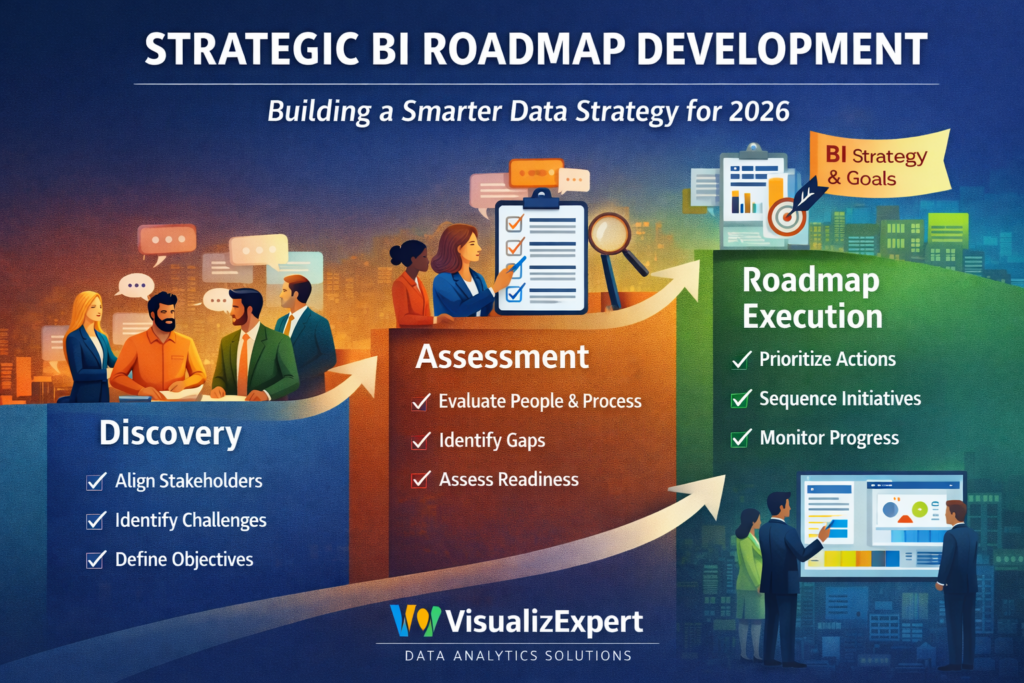
The engagement typically unfolds across three connected phases.
Phase 1: Discovery and Alignment
The first step is creating shared understanding.
This phase focuses on conversations—not dashboards. We bring together leaders, analysts, and operational teams to uncover:
- Key decisions that drive outcomes
- Current pain points and inefficiencies
- Where ownership is unclear
- What success actually looks like
This alignment phase often surfaces a critical insight: teams are solving real problems, but in isolation. A roadmap aligns those efforts into a single direction.
Phase 2: Capability and Maturity Assessment
Once goals are clear, the next step is understanding readiness.
This phase examines:
- How data flows today
- How insights are created and consumed
- Where friction, rework, or delays occur
- Whether current practices support future goals
Rather than focusing only on tools, this assessment looks at how analytics operates as a system. The outcome is a clear picture of what’s enabling progress—and what’s silently slowing it down.
Phase 3: A Prioritized Execution Roadmap
The final output is a clear, phased roadmap that connects today’s reality to tomorrow’s goals.
This roadmap:
- Defines what to do first, and what can wait
- Highlights dependencies and sequencing
- Sets realistic expectations around effort and impact
- Creates accountability without rigidity
Importantly, the roadmap is actionable whether teams execute independently or with continued support. It becomes a decision-making reference, not a static document.
Why Leadership Engagement Improves with a Roadmap
One of the most consistent outcomes of roadmap engagements is stronger leadership alignment.
Executives gain:
- Visibility into current-state challenges
- Context for prioritizing analytics investments
- Confidence that initiatives are connected—not random
- A shared language for discussing data strategy
Instead of approving isolated requests, leadership evaluates analytics as a coordinated portfolio of initiatives aligned to business value.
Supporting Modernization Without Creating Chaos
Many organizations pursue roadmaps while preparing for major transitions—cloud adoption, platform changes, or advanced analytics initiatives. Without structure, these efforts can create disruption instead of progress.
A roadmap helps organizations modernize with intent:
- Foundations are strengthened before complexity increases
- Experiments are guided, not scattered
- Risks are identified early, not after failure
This approach allows organizations to evolve their data capabilities without overwhelming teams or losing trust.
Governance That Enables, Not Restricts
Governance often gets delayed because it’s perceived as restrictive. In reality, governance becomes far easier when embedded within a strategy.
A roadmap reframes governance as:
- Clear ownership instead of control
- Consistent definitions instead of bureaucracy
- Responsible access instead of blanket restrictions
This balance supports scale, trust, and compliance simultaneously.
Culture and Adoption Matter More Than Tools
Analytics success is ultimately a human challenge.
A strong roadmap considers:
- How teams learn to work with data
- How insights are communicated
- How decisions are reinforced and measured
By addressing adoption and literacy alongside technical initiatives, organizations increase long-term ROI and reduce resistance to change.
Why VisualizExpert
VisualizExpert helps organizations move from reactive reporting to intentional analytics strategy. Our roadmap engagements are grounded in real-world experience across industries, growth stages, and analytics ecosystems.
We don’t just help you plan—we help you think clearly about data, decisions, and execution.
If your organization is heading into 2026 with growing data complexity and unclear priorities, a roadmap may be the most valuable analytics investment you make.
Get expert guidance from VisualizExpert—and build a data strategy that actually moves the business forward.
Leave a Reply