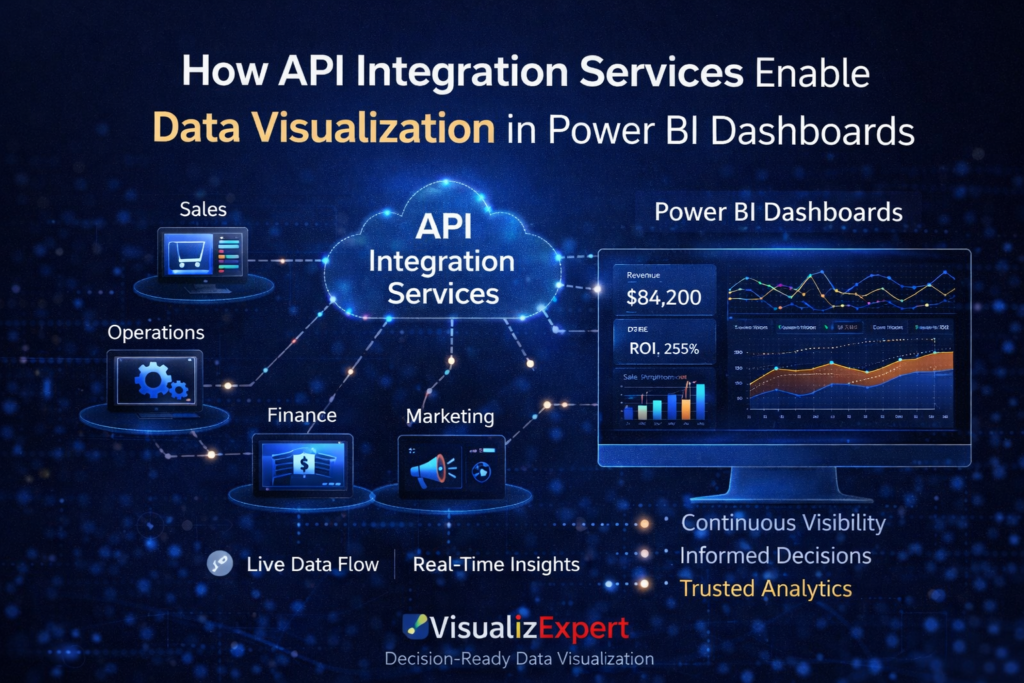
Modern businesses don’t struggle with a lack of data—they struggle with fragmented data. Sales lives in one system, marketing in another, finance somewhere else, and operations in spreadsheets no one fully trusts. This is where API Integration Services become the foundation of scalable analytics.
At VisualizExpert, we see a recurring pattern: organizations invest in Power BI dashboards, but insights remain delayed or incomplete because the data pipeline feeding those dashboards is brittle or manual. APIs solve this problem by enabling systems to communicate continuously, creating a live data backbone that fuels meaningful analytics.
This article explains how APIs enable Power BI visualization, what it takes to build them correctly, and why this approach delivers far more than faster reports.
Why APIs Matter More Than Ever in Business Analytics
APIs act as standardized messengers between systems. Instead of exporting files, scheduling uploads, or relying on human intervention, APIs allow platforms to exchange data automatically and securely.
For analytics teams, this unlocks something critical: trust. When dashboards update reliably and consistently, leaders stop questioning numbers and start acting on them. This is the hidden value behind effective data analytics services—not charts, but confidence.
As businesses scale, APIs become the only sustainable way to support advanced analytics and reporting consulting without operational drag.
APIs as the Foundation of Power BI Dashboard Development
A Power BI dashboard is only as good as the data model behind it. APIs allow Power BI to pull data directly from CRMs, ERPs, marketing platforms, and operational tools, eliminating manual syncs.
When implemented correctly, APIs support:
- Near real-time refresh cycles
- Consistent schema definitions
- Scalable data ingestion
This is essential for Power BI Dashboard Development that supports daily decision-making instead of retrospective reporting.
Defining the Objective Before Building an API
Every effective API starts with a business question. Is the goal performance monitoring? Forecasting? Executive reporting?
At VisualizExpert, we align API design with business intelligence consulting principles. That means defining:
- What decisions the dashboard should enable
- Which metrics matter most
- How frequently data must update
Without this clarity, APIs often become technical assets without business impact.
Structuring APIs for Enterprise Data Visualization
Once the objective is clear, API structure matters. Poorly structured endpoints lead to bloated models, slow dashboards, and confused users.
Well-designed APIs support:
- Clean fact and dimension separation
- Scalable Power BI data modeling
- Efficient refresh performance
This foundation enables reliable enterprise data visualization, especially as datasets grow in size and complexity.
Authentication, Security, and Governance
Security is not optional. APIs must protect sensitive business data while remaining usable for analytics teams.
Modern implementations rely on token-based authentication, role-based access, and controlled permissions. These practices align closely with Power BI integration services, ensuring only authorized data flows into dashboards.
Strong governance builds executive trust and supports long-term analytics adoption.
From Raw Data to Interactive Business Dashboards
Once APIs are live, their true value appears in how data is visualized. APIs allow Power BI to surface metrics across departments in one unified view.
This enables:
- Cross-functional KPIs
- Live operational monitoring
- Consistent definitions across teams
The result is interactive business dashboards that replace static reports and fragmented tools.
APIs and KPI Dashboard Services
Manual KPI tracking breaks down as businesses scale. APIs automate metric calculation and delivery, ensuring dashboards reflect reality—not outdated snapshots.
This is why APIs are central to modern KPI dashboard services. They allow metrics to update automatically, align across teams, and support accountability at every level.
Supporting Executive Analytics Dashboards
Executives don’t want raw data—they want clarity. APIs enable Power BI dashboards that aggregate performance across systems without delay.
With the right API architecture, executive analytics dashboards answer questions instantly:
- Are we growing profitably?
- Where are risks emerging?
- Which channels deserve more investment?
This is where APIs directly influence strategic outcomes.
Why API-Driven Dashboards Outperform File-Based Reporting
File-based reporting introduces delays, errors, and version conflicts. APIs remove these risks by creating a continuous data flow.
This shift supports decision-ready data visualization, where insights are available when decisions are made—not weeks later.
Power BI Managed Services and API Operations
APIs require monitoring, maintenance, and optimization. Without ownership, integrations degrade over time.
Through Power BI Managed Services, VisualizExpert ensures APIs remain reliable, scalable, and aligned with evolving business needs. This includes performance tuning, schema updates, and integration reviews.
APIs Enable Advanced Power BI Reporting Solutions
When APIs power dashboards, teams can move beyond basic charts to advanced analytics:
- Trend detection
- Anomaly monitoring
- Cross-platform comparisons
This elevates dashboards into full Power BI reporting solutions that support both tactical and strategic use cases.
The Role of Data Visualization Services
APIs deliver data—but visualization delivers understanding. Strong data visualization services ensure API-fed dashboards communicate insight clearly, without clutter or confusion.
This balance between engineering and design defines analytics maturity.
APIs as Part of a Strategic BI Roadmap
API integration is not a one-off project. It’s a core pillar of Strategic BI Roadmap Development.
Organizations that treat APIs as long-term assets achieve:
- Faster analytics delivery
- Lower operational costs
- Higher analytics adoption
This approach ensures dashboards evolve alongside the business.
From Data Access to Data Driven Decision Making
Ultimately, APIs exist to support better decisions. When systems talk seamlessly, leaders act confidently.
This is how API-driven dashboards enable true Data Driven Decision Making—not by adding more data, but by removing friction.
Why Founders and Leaders Should Care
For founders, speed matters. APIs eliminate delays between activity and insight, allowing rapid course correction.
For leaders, accuracy matters. APIs reduce manual errors and inconsistencies, strengthening trust in analytics.
Both benefit from dashboards that are always current and reliable.
VisualizExpert’s Approach to API-Powered Analytics
At VisualizExpert, we design APIs with outcomes in mind. Our work blends engineering discipline with analytics strategy, ensuring dashboards support real decisions.
As a specialized Data Analytics Agency, we help organizations connect systems, design scalable integrations, and transform raw data into insight leaders trust.
Final Thoughts
APIs are not just technical connectors—they are the nervous system of modern analytics. When designed intentionally, they turn Power BI dashboards into living tools for action.
If your dashboards rely on delayed extracts or manual updates, the limitation isn’t Power BI—it’s the pipeline behind it.
With the right API strategy, visibility becomes continuous, decisions become faster, and analytics finally delivers on its promise.
At VisualizExpert, we help businesses build that foundation—so insights move at the speed of the business, not the reporting cycle.
Leave a Reply