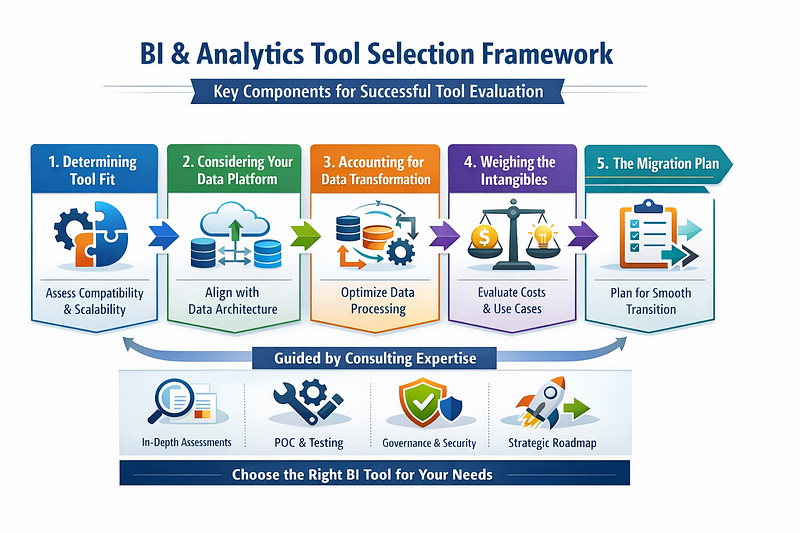
Introduction: Why BI Tool Selection Fails More Often Than It Should
Selecting a BI and analytics platform is no longer a purely technical decision — it is a strategic one that directly influences how leaders interpret data and act on it. Organizations often invest months evaluating tools, yet still struggle with adoption, performance, or trust in insights. This is where Power BI consulting services play a critical role, helping businesses move beyond surface-level comparisons and toward platforms that truly align with their data maturity, operating model, and long-term goals.
At VisualizExpert, we’ve seen a consistent pattern: BI tools fail not because they lack features, but because they are selected without a structured evaluation framework. A successful BI selection process balances architecture, usability, scalability, governance, and future readiness. This article outlines a practical BI and analytics tool selection framework — one that prioritizes real-world decision impact over vendor hype.
Why a Framework Matters More Than a Feature Checklist
Modern BI platforms all promise speed, self-service, AI-assisted insights, and beautiful dashboards. Yet organizations still face dashboard sprawl, inconsistent metrics, and slow decision cycles. The problem lies in how tools are selected.
A framework forces clarity around:
- Who will use the tool and how
- Where data transformation should live
- How governance and scalability will be enforced
- What success looks like after implementation
Without this structure, even best-in-class tools become underutilized reporting layers instead of decision engines.
Core Component 1: Determining True Tool Fit
Tool fit goes beyond compatibility with data sources. It evaluates how well a BI platform integrates into your organization’s operating reality — today and three years from now.
Key considerations include:
- Alignment with your current and future data architecture
- Learning curve for both analysts and business users
- Licensing model sustainability as adoption grows
- Performance under real data volumes and concurrency
The most successful BI environments are not those with the most dashboards, but those where analytics naturally integrates into everyday decision-making. Fit should be validated through hands-on proof-of-concepts that mirror real workflows, not sanitized demos.
Core Component 2: Data Platform Alignment
BI tools do not exist in isolation. They sit at the top of your data stack and depend heavily on what exists beneath them.
Organizations generally fall into one of three platform scenarios:
Modular Data Platforms
These environments combine best-of-breed tools for ingestion, transformation, storage, and analytics. The BI tool must work efficiently with cloud warehouses, semantic models, and transformation layers without duplicating logic.
Vendor-Centric Cloud Platforms
Unified ecosystems provide deep integration benefits but often nudge organizations toward native BI tools. While this can accelerate deployment, it may also introduce long-term vendor dependency that must be evaluated carefully.
No Centralized Data Platform
In less mature environments, the BI tool often absorbs responsibilities it was not designed for — data preparation, transformation, and even storage. This can work short-term but introduces technical debt unless paired with a roadmap toward centralization.
Understanding your platform direction is essential before locking in a BI tool.
Core Component 3: Where Data Transformation Should Live
One of the most overlooked decisions in BI selection is where transformation logic resides. While many BI tools allow data shaping, relying on them as the primary transformation layer limits scalability and complicates future migrations.
Best-practice principles include:
- Centralizing complex transformations in the data platform
- Keeping BI-level calculations lightweight and presentation-focused
- Designing semantic models that remain portable across tools
This separation ensures performance, governance, and long-term flexibility — especially as data volumes and user counts increase.
How Power BI Consulting Services Improve BI Tool Selection Outcomes
Organizations that engage experienced Power BI consulting services during the selection phase consistently achieve higher adoption and faster time-to-value. This is not because consultants push a specific tool, but because they bring a decision-first mindset.
Consulting-led selection helps organizations:
- Translate business decisions into analytics requirements
- Identify hidden architectural constraints early
- Stress-test tools under realistic workloads
- Design governance and security models before rollout
Rather than asking “What can this tool do?”, the conversation shifts to “What decisions must this tool support reliably?”
This approach reduces rework, minimizes shelfware, and ensures the BI platform evolves with the organization — not against it.
Core Component 4: Weighing the Intangibles
Technical capability alone does not determine success. Intangible factors often make or break BI adoption.
Licensing Trajectory
Costs rarely stay flat. Organizations must model how licensing scales with usage, viewer counts, and premium features — not just initial pricing.
Real Use Cases Over Feature Depth
Advanced functionality has little value if it does not support actual decision scenarios. Prioritize the workflows that matter most to leadership, operations, and frontline teams.
Vendor Momentum and Ecosystem
An active product roadmap, strong community, and skilled talent pool signal long-term viability. A stagnant ecosystem increases future risk.
These factors are difficult to quantify — but ignoring them is costly.
Core Component 5: Migration as a Strategic Opportunity
Migration should never be treated as a lift-and-shift exercise. It is a rare opportunity to clean, rationalize, and improve your analytics environment.
Successful migration planning addresses:
- Which reports truly deliver value
- Whether required data is accessible and trustworthy
- How change management will minimize disruption
Phased cutovers, parallel runs, and strong communication ensure users trust the new platform from day one. When executed well, migration accelerates adoption rather than slowing it.
Key Takeaways for BI Leaders
- BI tool selection is a strategic decision, not a procurement task
- Architecture, governance, and usability matter more than feature volume
- Data transformation should be centralized, not buried in dashboards
- Intangibles like licensing and ecosystem health shape long-term success
- Migration is a chance to reset — not replicate — analytics debt
Most importantly, the right BI tool is the one that consistently supports better decisions at scale.
Why VisualizExpert Approaches BI Differently
At VisualizExpert, we believe analytics should reduce cognitive load — not add to it. Our approach focuses on decision clarity, scalable design, and long-term adaptability. Tool selection is never about trends; it’s about fit, trust, and measurable impact.
If your organization is evaluating BI platforms or reassessing its current analytics stack, a structured framework — and the right expertise — can mean the difference between dashboards that impress and analytics that actually perform.
Leave a Reply